

Blog post written by Panagiotis Lampropoulos, former LLM student and currently Research Assistant in CREATe.
On April 17-19th I had the honour of attending the Race + IP Conference in the United States hosted by Pittsburgh University and organized by Anjali Vats. This biennial conference is dedicated to cultivating community and collaboration around the study of race, coloniality and intellectual property in an international intellectual space. The conference featured 10 plenary and concurrent panels, exploring coloniality, racism, exclusion, nationalism, carcerality, religion and other markers of identity, including a mixture of academics from legal and non-legal backgrounds, activists, practitioners and creators, and aiming to cultivate a culture of solidarity and kinship in an area of study which can often be lonely and disheartening.
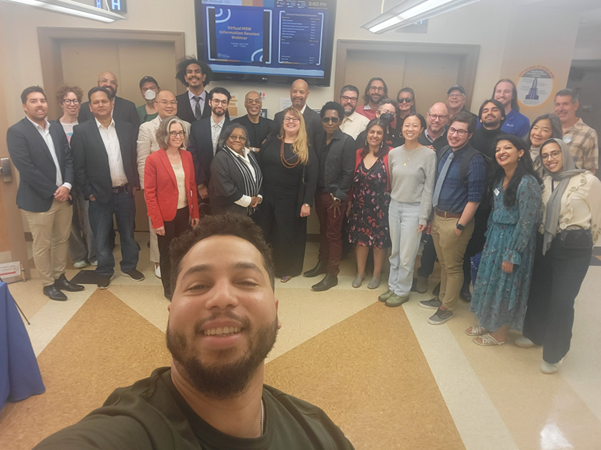
Race + IP 2025 conference speakers
On Friday 17th April, participants were welcomed by Anjali Vats, who introduced this year’s theme, “Abolitionist Futures”. In light of a recent X/FKA Twitter exchange between Elon Musk and Jack Dorsey calling for the deletion of all IP laws, she introduced the theme by distinguishing the conference’s aim of re-imagining an IP regime that fosters collaboration between creators by protecting without policing, as opposed to a neoliberal breakdown of all IP laws to facilitate the appropriation of work by AI developers. Moreover, the current tumultuous political climate threatening not only the study of themes engaged in by this conference, but also its very existence, was stressed in order to highlight the urgency of seeking solutions to information dissemination and exploration through IP laws. This was followed by a keynote speech by Celnisha Dangerfield, who added a historical touch to the conference theme by opening an ever-eye opening discussion regarding Sojourner Truth’s use of intellectual property to reframe her narrative and resist the limits of place, enforced upon her by her blackness and womanhood.
IP abolitionism can be used to achieve various just goals connected to copyright, whether to challenge its contextual situation within a colonial, white supremacist, nationalistic world holistically, or to challenge its structure, emanating from said context. During the first day of panels, a variety of speakers from different contexts introduced topics identifying those problems in both IP as well as creatorship generally. Speakers from AbolishIP framed abolitionism as care, through the intolerance of normalized forms of colonial and racial violence, and a shared commitment to stop forms of violence and create life-affirming ways of being, not by rejecting IP, but as a duty to care for each other, and our ecology. They therefore presented the use of a Creative Commons license limiting use of work to those who abide by a duty of care to Palestinian life, demonstrating the ways in which abolitionism can be used as a means of ensuring IP rights are actively used as tools to fight injustice in the global context surrounding it.
In the same vein, panellists Andrea Wallace and Julia Nguyen explored the ways in which the under commons can amount to liberatory framework of IP. Julia discussed how the traditional use of IP law discourse perpetuates a citizen/pirate dichotomy and separates creativity into the acceptable, legal framework of rugged individualism, usually limited by whiteness and masculinity, in the pursuit of the American dream and IP resistant pirates and terrorists, who are usually people of colour and those indigenous to the global south. Thus Julia presented fugitive studies as a framework through which to explore the under commons as a space within which people who have been denied resources are joined not by the common use or ownership of space, but by belonging within the community of those excluded. Similarly, Andrea presented the under commons as a liberatory infrastructure, according to which the European droit morale tradition can provide a model of fair use under the liberatory structure of the under commons. These discussions led scholars in attendance to contemplate how the lens of fugitivity, droit morale and the concept of the under commons inform visions of an abolitionist future for intellectual property, as well as imagining new possibilities for ownership, access and creativity.
Furthermore, we heard from activists Felicia Savage Friedman and Amanda K Gross, as well as local street artist GEMS, who demonstrated the way in which the practices of Yoga and graffiti are used as forms of shared IP, and challenged the need for artistic ownership. On one hand, the nature of Yoga, and, on the other hand, Felicia and Amanda’s goal of aligning their work with their shared intersectional, anti-racist analysis, maintain ongoing relationality. These issues do not rely uncritically on status quo, legalistic models, and instead led them seeking an IP agreement for two works that reflected those terms. GEMS, a well-known Pittsburgh-based, and formerly most-wanted street-artists community in the city, regularly produces anti-racist street art. In an interesting thought experiment, they outlined an experience, where they came across applicants using their work in portfolios in applications they were on the panel for. Those artists, being African-American, were led to view the line between claiming ownership and serving the communities within which they exist as murky.
Particularly interesting to me was a presentation by Kali Murray, who used the example of runaway slave advertisements to help us understand the relationship between trademark law and enslavement. This is connected to her larger academic interest of viewing intellectual property as despotic information, which she uses as a legally protected form of information that can create and reinforce unequal legal status based on social identity.
Other presentations explored the use of Black bodies and voices as anonymous characters in sport videogames by Joseph Coppola, explorations of the consistency between eighteenth-century arguments justifying copyright with those justifying colonialism, racial biases in empirical studies regarding IP and the weaponization of data protection in the TikTok litigation in America to promote a xenophobic movement, among others.
My presentation was a part of a larger panel on erasures, reclamations, and rewritings in knowledge. Closely relating to CREATe’s ‘Freedom of panorama: making copyright law (in)visible’ project, I presented an abolitionist analysis of the place of copyright of artwork permanently placed within physical public spaces. Specifically, by examining the application of exclusive rights and the limited current application of freedom of panorama in the UK, analysed in relation to contemporary urban resistance movements such as the 2020 Black Lives Matter Protests, I argued that the existence of models of ownership over the culture which emanates from public spaces within a city inevitably leads to a hierarchy of types of creativity, which grants more value to colonial statues, than works resulting from resistance to them. I thus came to the conclusion that a communal moral right together with absolute freedom of panorama ought to be established in order to abolish hegemonic interests from public spaces and democratise creativity.
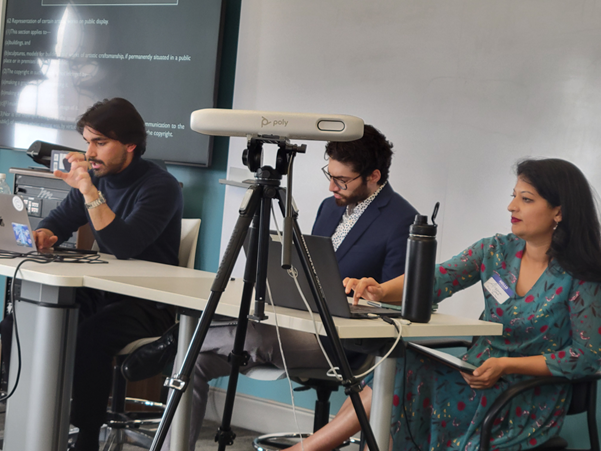
Panagiotis presenting on the panel on Erasures, Reclamations, and Rewritings in Knowledge Practices, first from the left
Together with co-panellists Ashtin Berry and Sami Ahmad, who presented research on food and drink as cultural IP, an engaging discussion was opened on what it means for physical bodies to claim identity through nutrition, healing and physical presence.
Along with the above-mentioned panels, the conference also included a live action role-play (LARP), which simulated the fictitious Cosmic Arts Copyright Convention Towards More Equitable Systems for All Beings, inspired by Derrick Bell’s “The Space Traders”. The activity instructions called on four committees, representing different beings, to design the most abolitionist, non-reformist reforms to copyright law that balance the interests of racial justice with stable change. Whilst scholarly panels are useful in providing grounded research, the implementation of realistic legal solutions to complex problems can often be limited compared to scholarly goals. Such pedagogical tools provide a refreshing opportunity to explore our shared goals and values, without those limitations, in order to collectively articulate them, and thereby inform our research.
In conclusion, the Race + IP conference highlighted the idea that an abolitionist approach to copyright scholarship does not merely involve the deletion of copyright jurisprudence, but rather the constant re-examination of seemingly neutral laws through their colonial origins, as well as their inequitable impact on marginalised communities, due to the context within which they are situated. In producing work providing doctrinal analysis, the contributions which lawyers make on the field can be limited and reformist, which is why one of the great strengths of the conference was that it brought together a variety of individuals involved in work related to its themes, highlighting the value of expert contributions, combined with professional, practical and lived experience.