


 EPIP 2024 took place in the historic and beautiful city of Pisa, Italy, from 11 to 13 September. The overarching theme of the conference was ‘Intellectual Property and the Future of the Data Economy’. The main objective was to bring together academics from different fields, as well as stakeholders and policymakers, to discuss the interplay between IP systems and the new data economy. With the increasing importance of new digital services, artificial intelligence (AI) and other digital technologies for innovation and creativity, data plays a fundamental role. This is a pressing issue that has received increasing attention from academics and policymakers in recent years.
General overview of EPIP 2024
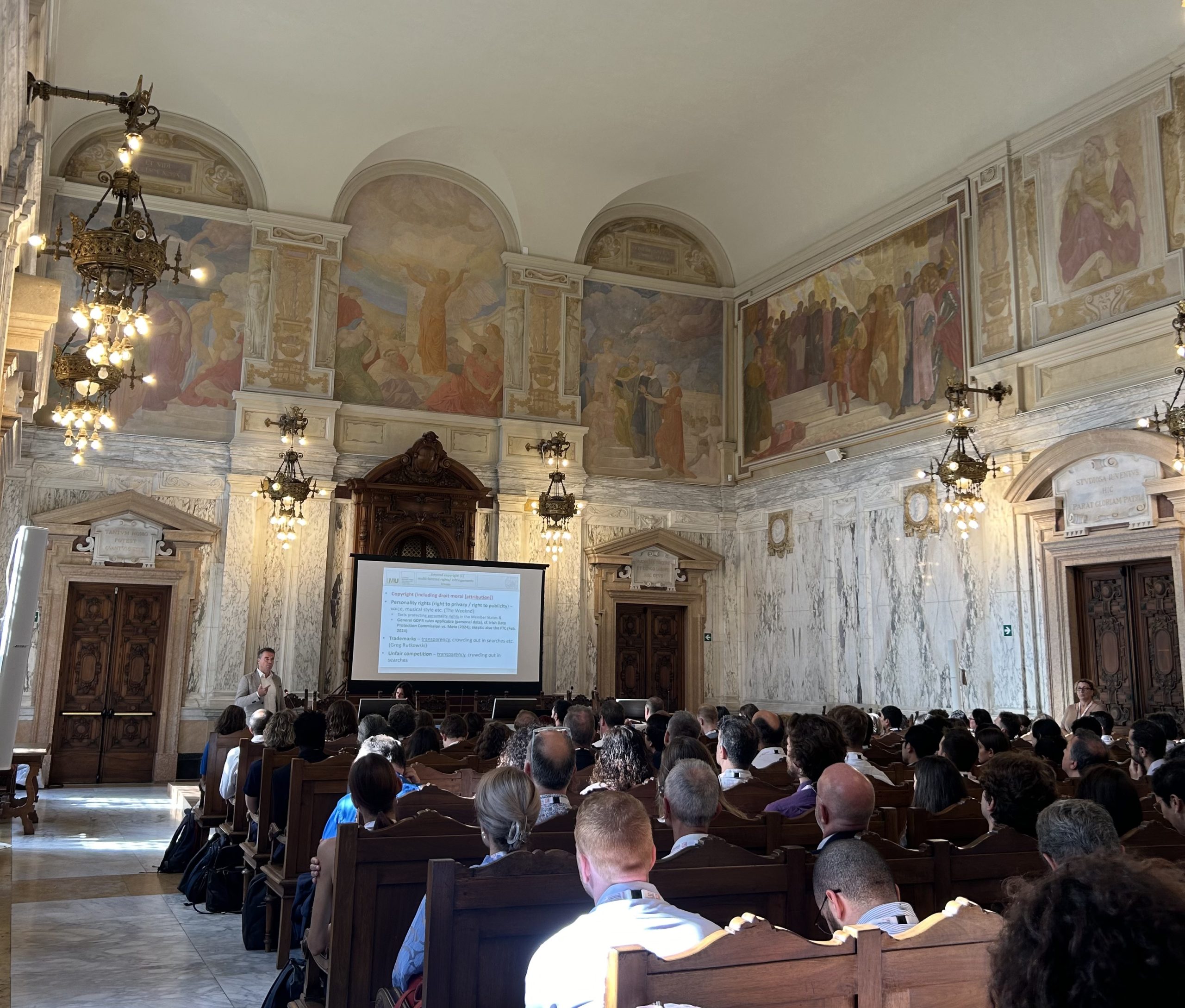
Organised by Scuola Superiore Sant’Anna, in cooperation with the University of Pisa, EPIP 2024 had a record number of submissions, as the chair of the organising committee and new EPIP president, Caterina Sganga, highlighted in her welcome speech. Over two and a half days, participants were able to attend two keynote speeches, five plenary roundtables and choose from a range of sponsored, special and thematic sessions as well as parallel panels covering empirical, doctrinal and policy research on all different aspects of IP, data and related topics. As expected, AI was at the centre of the debate. In the age of ChatGPT, DALL-E, Midjourney and other generative AI and algorithmic tools, there are many questions about the impact of these systems on creators, inventors and the society as a whole, and how courts, policymakers and legislators shall address these issues.
As Matthias Leistner pointed out in his keynote speech ‘AI as a global challenge to copyright’, this discussion goes far beyond copyright and other intellectual property rights. There are many ethical and policy challenges that need to be addressed. A lot has been said about the recently adopted Artificial Intelligence (AI) Act. For example, within IP law, how the AI Act and its general transparency obligations can be used with other legal instruments from different areas of law, such as copyright, trademark, personal and privacy rights and unfair competition, to protect creators. However, its extraterritorial application has rarely been questioned. Given the increasing focus of EU regulation on market-effect rules, many have assumed that a process of unilateral regulatory globalisation (the ‘Brussels effect’) would occur with the AI Act, as has happened with the GDPR. In doing so, many have overlooked legal principles, such as the ‘lex loci’ (or ‘law of the place’) protection principle, and other geopolitical and policy issues. Looking at possible approaches, Leistner also asked: ‘what results must be in’? So what comes next? These are questions that many of the researchers presenting at EPIP this year have also addressed.
However, AI is not the only topic of interest for IP scholars in Europe and across the globe. Other pressing issues related to IP and the new data economy, such as sustainability, open science, science and innovation, data and IP governance, transparency, creators’ remuneration and copyright flexibilities, were also addressed during the conference. In the themed sessions, for example, researchers analysed the importance of transparency in music data as an imperative to promote creators’ fair remuneration and diversity. One of the questions was whether regulation can fix the problems caused by the lack of data transparency in the digital music sector. There were also discussions on IP governance in times of global crisis, with questions about the development of a ‘responsible’ IP system and a green IP regime for environmentally sound technologies, the importance of technology transfer for developing countries and alternative technology facility mechanisms in the context of the Sustainable Development Goals (SDGs). Other sessions covered topics such as the uneven geographical standards, the need for a paradigm shift in IP law in a circular economy, data and trade secrets, and the importance of digital legislation for research.
As part of EPIP tradition, roundtables with Economists at IP Offices, policymakers and representatives of the judiciary were also held to discuss the challenges posed by new technologies and how they are being addressed in their work. For example, the importance of setting a new legal framework and the limits of what judges can do in the absence of legislation covering these new technologies were some of the issues discussed.






CREATe at EPIP 2024
As mentioned in our first blog ‘CREATe at EPIP 2024’, CREATe members were also in Pisa to present their research, on different topics, ranging from pharmaceutical patents to transparency obligations and technological protection measures (TPMs).
On 11 September, Gabriele Cifrodelli kicked off one of the first parallel sessions by presenting his recently published paper: ‘Can you patent the sun? Towards a sui generis Inclusive Right to manage the relationship between Intellectual Property and Commons’. Gabriele mostly focused on the main reasons why we should rethink the current normative approach for the protection of Covid-19 vaccines and other life-saving treatments (especially during a global emergency such as the pandemic), and what could constitute an effective enforcement mechanism if Commons for such resources were theorized. The presentation inevitably sparked some discussion afterwards, for instance with regard to the nature and scope of the inclusive right and whether there could be other viable solutions (still in the context of Commons).
Martin Kretschmer (former president of EPIP and chair of EPIP 2015 at Glasgow) was involved in various sessions throughout the conference. Still on the first day, together with Thomas Margoni, he organised and chaired the special session on ‘Lawful access in EU (copyright) law’. The main goal was to discuss the slippery concept of ‘lawfulness’ that appears in many domains of law and which, in copyright law, has become a condition for the availability of exceptions in the form of ‘lawful use’, ‘lawful access’ and ‘lawful source’. This debate was triggered by their research on ‘The Paradox of Lawful Access’, which was presented at the 2024 European Copyright Society Conference in Frankfurt. In their research, they question whether it is not a paradox to require lawful use when the main purpose of exceptions is to transform an act that could be considered unlawful into a lawful act that does not require permission. Discussants Martin Seftleben, Léo Pascault, Michael Birnhack, Bernd Justin Jütte, Christophe Geiger, Kacper Szkalej and Mando Rachovitsa were asked how their work addressed ‘lawful access’ in the context of a data-driven technological framework and whether the concept acts as a (disguised) attempt to reallocate rights and obligations (or even power).
On 12 September, Martin was part of the plenary roundtable ‘Blurred lines: data governance, data ownership and intellectual property rights’, chaired by Tanya Aplin. Together with Maria Savona, Luis Aguiar and Niva-Elkin Koren, Martin discussed whether IPRs (i.e., copyright, trade secrets, database rights), by embracing the protection of compilations or collections of data and datasets, do not provide a kind of ‘data ownership’ and how this impacts data governance. In the light of the new EU digital regulatory framework (eg Data Governance Act, Data Act, AI Act and Digital Services Act) and their research on data access, the discussants were asked, for example, whether data governance mechanisms inevitably cause friction with IP rights or whether it is possible to align them. In particular, they were questioned whether it is time to exclude protection of ‘data’ via IPRs and only to protect expressive content, and whether the focus should be on improving private ordering mechanisms to facilitate data sharing. In his presentation, Martin focused on the different (and overlapping) regulatory fields involved in data governance, from IP law to data/information law, competition law, content/media law, and how the IP approach, which mainly relies on private litigation, differs from the other areas, which are based on ex ante or risk-based regulation anchored in public/administrative law. The starting point for this regulatory fields analysis was the paper ‘The emergence of platform regulation in the UK’.
On 12 September, Martin also chaired a session on ‘Remunerating creators: recent reforms and policy recommendations’. Séverine Dusolier opened the session discussing fair remuneration of authors and performers in the music streaming economy. She outlined the factors that contribute to unfair remuneration distribution, the main legal issues and the legal proposals, such as a statutory right to remuneration, to address this problem, in particular ‘how to restore the value of music as creative works not as a flow of consumable content’. In other words, how to move beyond copyright as a commodity. Marina Markellou also presented her work on ‘Have your cake and eat it, too’ – A quest for contractual identity in European copyright law for the “Digital Decade”’ and Rafal Sikorski discussed the ‘Remuneration of authors and performers for on-demand users of audiovisual works’.
As part of this session, Ula Furgał and Aline Iramina presented their research on ‘Investigating transparency: the screenwriters edition’. In the context of the 2019 Copyright in the Digital Single Market Directive (CDSMD), they explained how research on creators’ remuneration has focused on the music industry, and how transparency obligations (Article 19) have received much less attention than other legal mechanisms provided for in Chapter 3 of the CDSMD to increase creators’ bargaining power. As such, the importance of analysing transparency in the audiovisual industry. In this case, with the focus on screenwriters. As Ula and Aline explained, their research addresses three questions: ‘What is the standard of transparency in the audiovisual sector?’, ‘What information screenwriters have access to in the context of streaming?’ and ‘Have standards changed post art. 19 CDSMD?’ They presented their initial findings based on a legal and empirical analysis of the implementation of Article 19 in the EU Member States and the collective agreements in the audiovisual sector supplied by the Federation of Screenwriters in Europe (FSE) and the Federation of European Film Directors (FERA) member organisations. For this research they used CREATe’s CDSM implementation resource page and the collective bargaining for audiovisual authors database. One of their findings is that it is not possible to establish what is the transparency standard in the audiovisual sector based on the legal framework and collective agreements alone. Moreover, collective agreements do not (yet) reflect Art. 19 CDSMD. As this is a work in progress, the next steps are to interview representatives of screenwriters’ organisations in Europe.
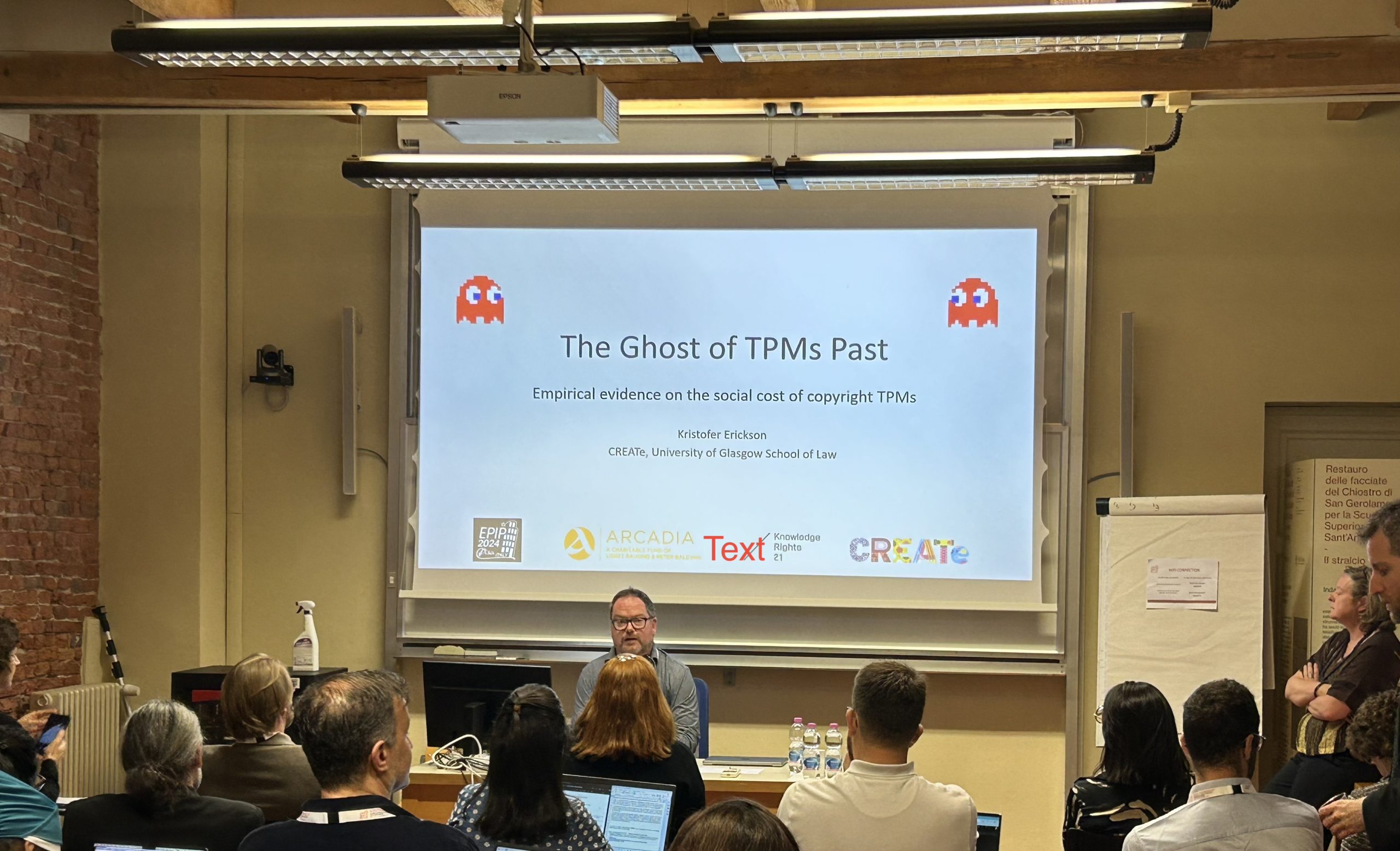
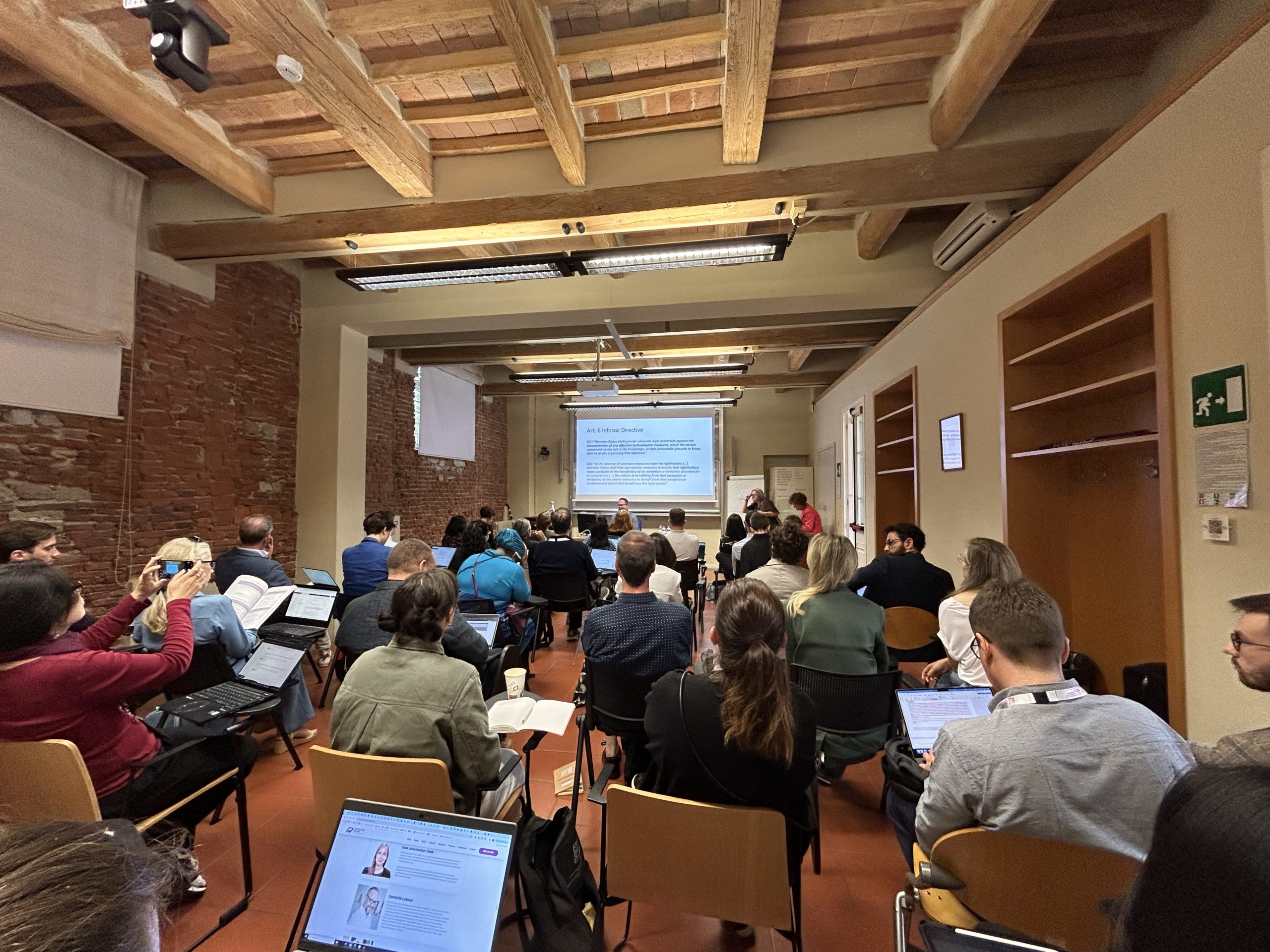
Finally, on 13 September, CREATe Deputy Director Kristofer Erickson presented his work on ‘The ghost of technological protection measures past: empirical evidence on TPMs in preservation and research.’ His presentation was based on two related empirical studies funded by Knowledge Rights 21: 1) a survey interrogating current practices of library institutions from selected territories across Europe and reporting on their encounters with TPMs across the range of digital content; and 2) a study using machine learning to examine the social and economic effects of TPMs in video game preservation. As part of his initial findings, he highlighted the current practices and frustrations of research, education and preservation institutions in dealing with TPMs. He also addressed the challenges posed by TPMs for research and institutional users and some of the policy issues involved.
All these research projects and studies are part of the work of CREATe, now Centre for Regulation of the Creative Economy, in the fields of intellectual property, technology and markets.
EPIP 2025: Turning IP ambitions into action: creating connections, collaborations and communities
As announced at the EPIP General Assembly, the 20th Annual Conference of the European Policy for Intellectual Property Association will be hosted by the Faculty of Law of the University of Antwerp, in Antwerp, Belgium, from 10 to 12 September 2025. The overarching theme of EPIP 2025 will be ‘Turning IP ambitions into action: creating connections, collaborations and communities’. The main objective will be to explore the evolutions related to IP in the context of global societal challenges. In particular, how to turn IP ambitions into action, by fostering meaningful connections, setting up effective collaboration between different actors and building communities.
As a reminder, the EPIP call for papers is usually announced in February of each year.