

In this blog, CREATe academic Dr Elena Cooper connects her work as Arts Reviews Editor for the academic journal Law and Humanities to learning from the AHRC-funded conference ‘From Scotland to the World: Repatriation and Museums’ held in Glasgow in April 2024, convened by CREATe in partnership with The Hunterian and the Institute of Art and Law.
‘MAN: It’s a legal matter you see, there’s
WOMAN: The British Museum Act, / I know
MAN: So then you know. Our board of trustees… Their hands are tied. I mean it’s… Not pretty but it’s a finicky law.’
These are words from Scenes from a Repatriation (script p.48-49), a new play by playwright Joel Tan currently playing at the Royal Court, London, about the fictional repatriation of a sacred thousand-year-old statue of the Bodhisattva Guanyin from the British Museum to China, following the discovery by a London-based academic of its disturbing provenance: the man who donated the statue to the museum in 1917 was ‘practically a grave-robber’ and the paper trail proving the statue was stolen survives in a Paris archive (Ibid. p.16-17). What can and should the British Museum do? And what happens to the statue after its return to China? These are the themes unfolded in Tan’s new drama, in a production directed by Emma + pj and performed by a cast of 6 actors: Kaja Chan, Aidan Cheng, Jon Chew, Fiona Hampton, Robin Khor Yong Kuan and Sky Yang (photos below). In staging this new play, that speaks to events on the world-stage later this year – ethical guidance on repatriation is one topic to be debated by the International Council of Museums at their Dubai meeting this November – the Royal Court again lives up to its longstanding reputation as the home of new and provocative writing that speaks to the present moment.
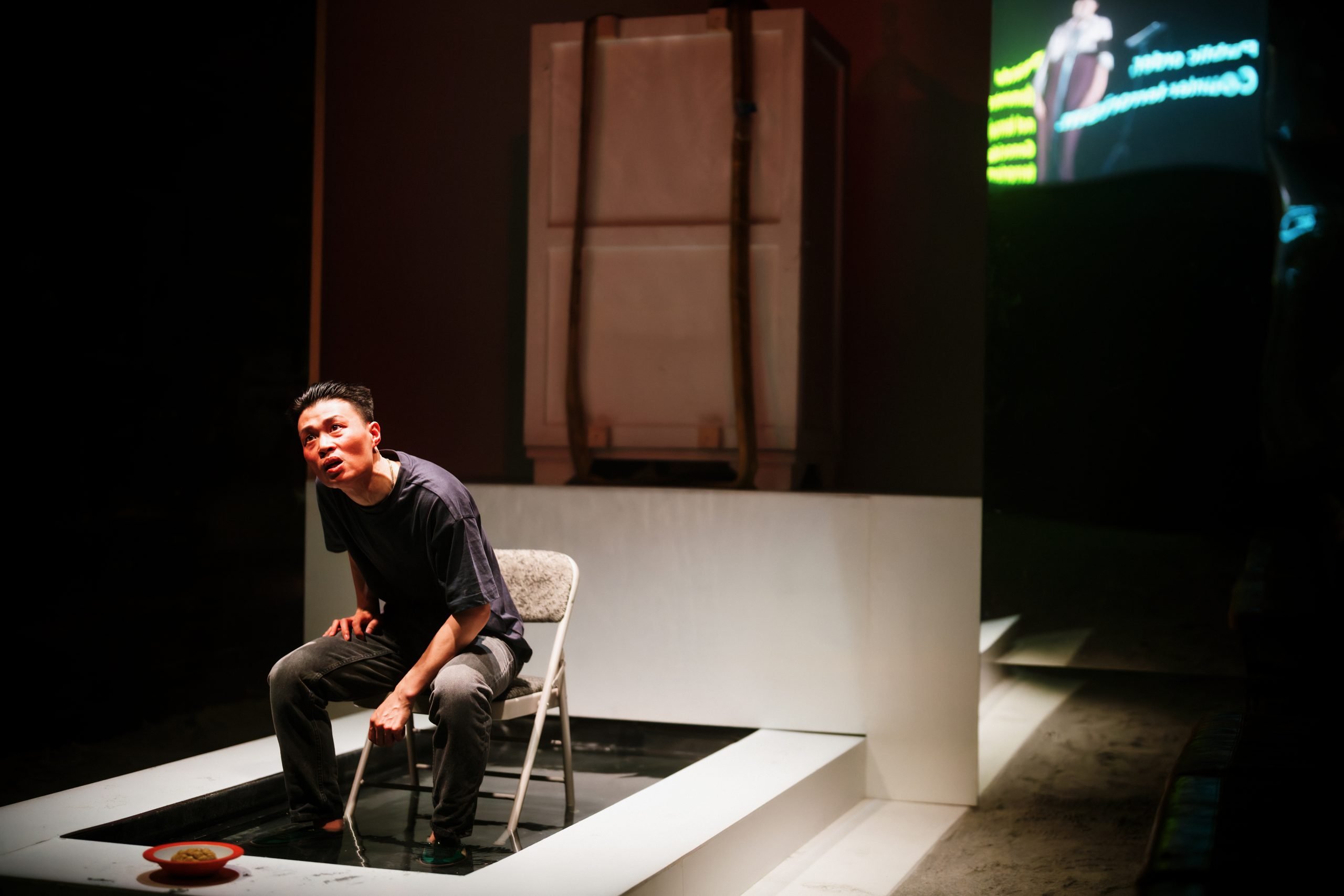
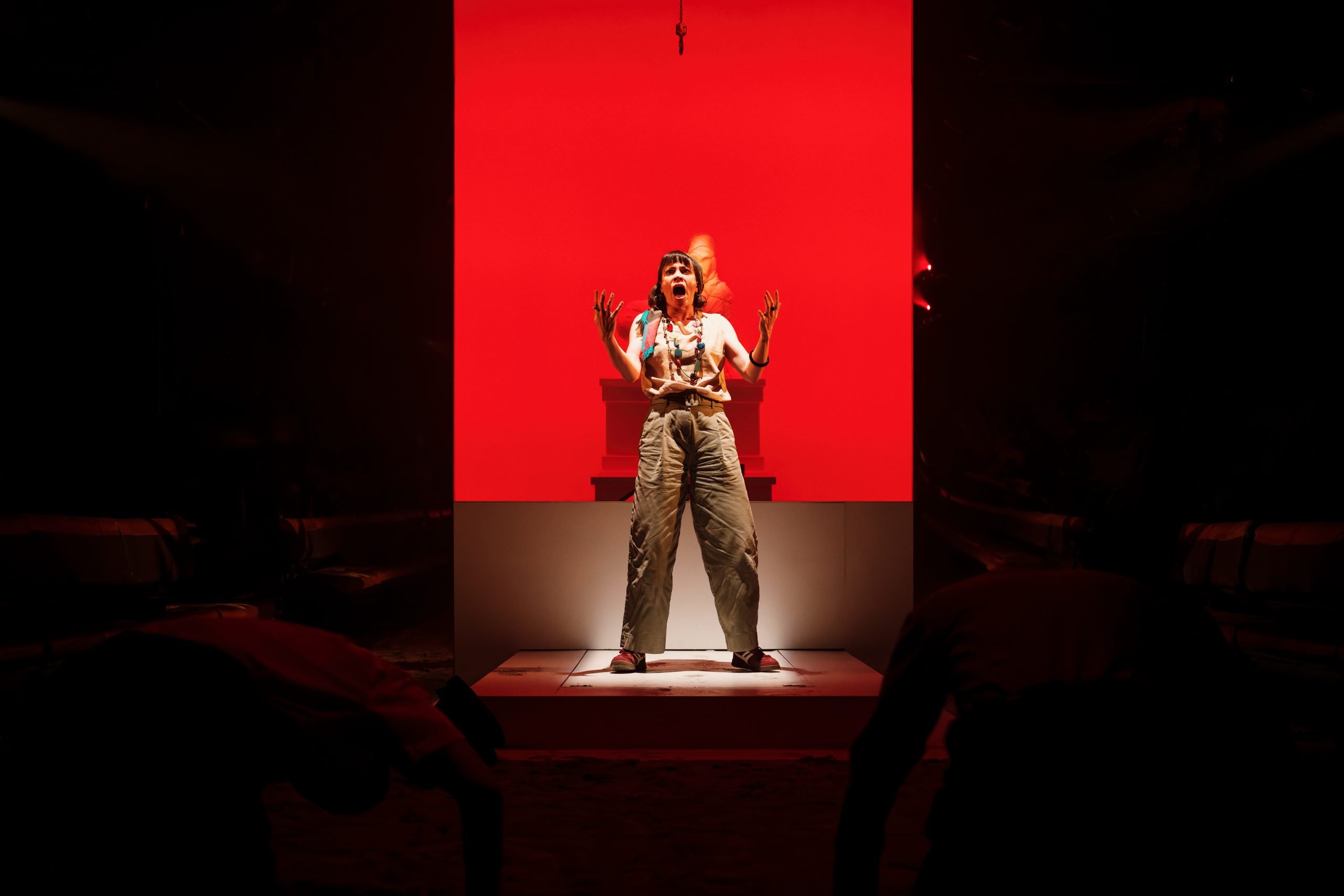
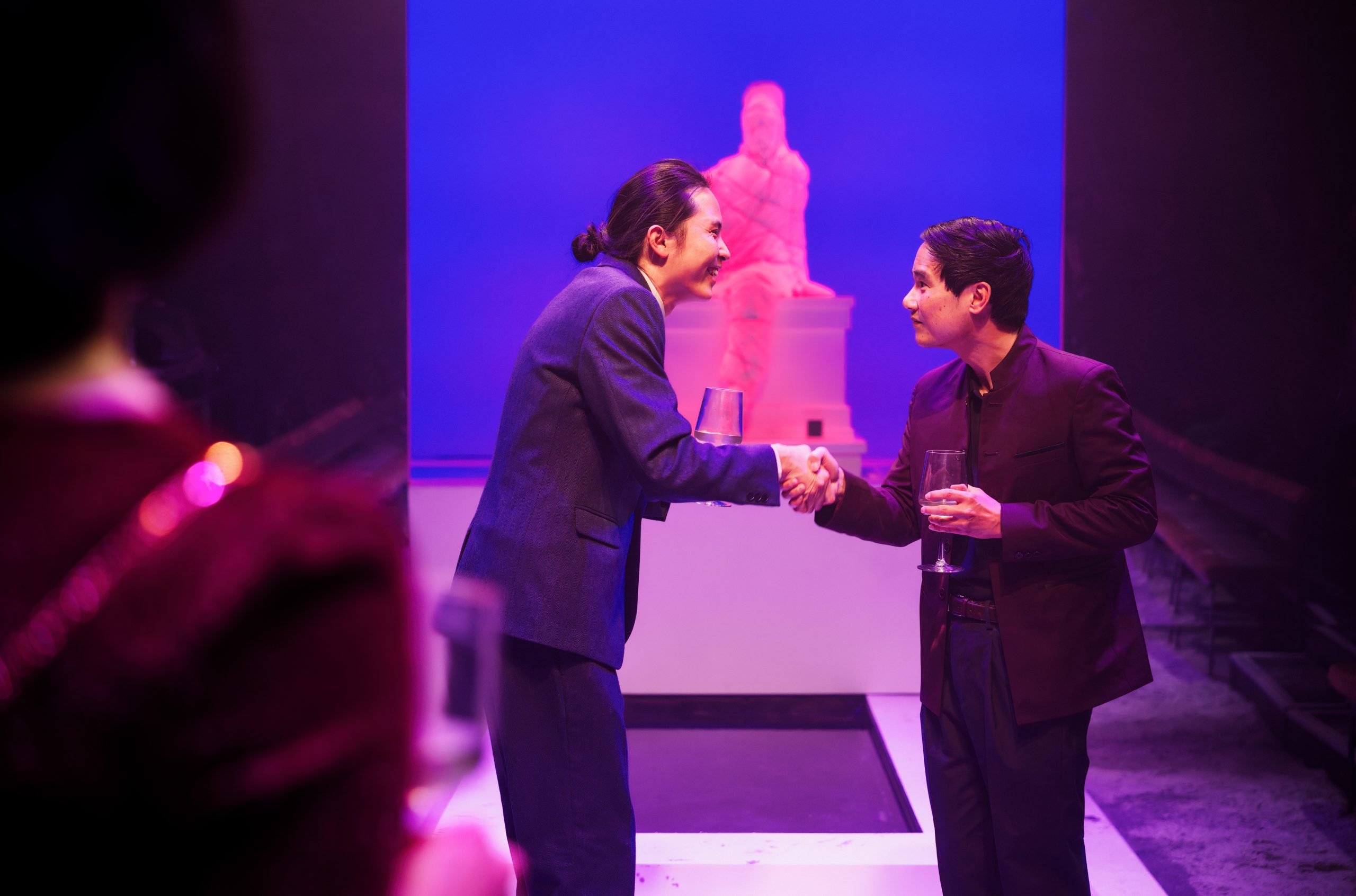
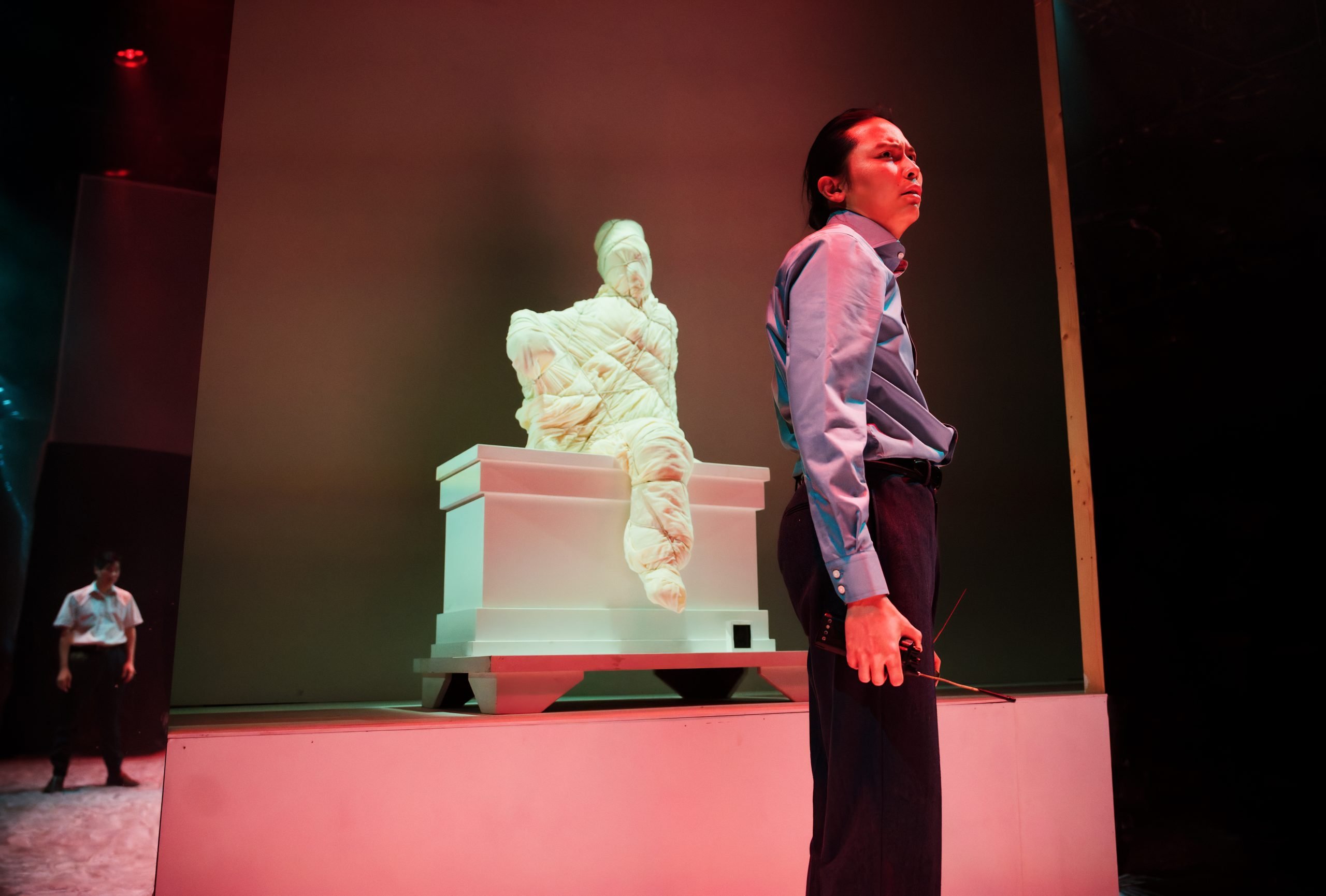
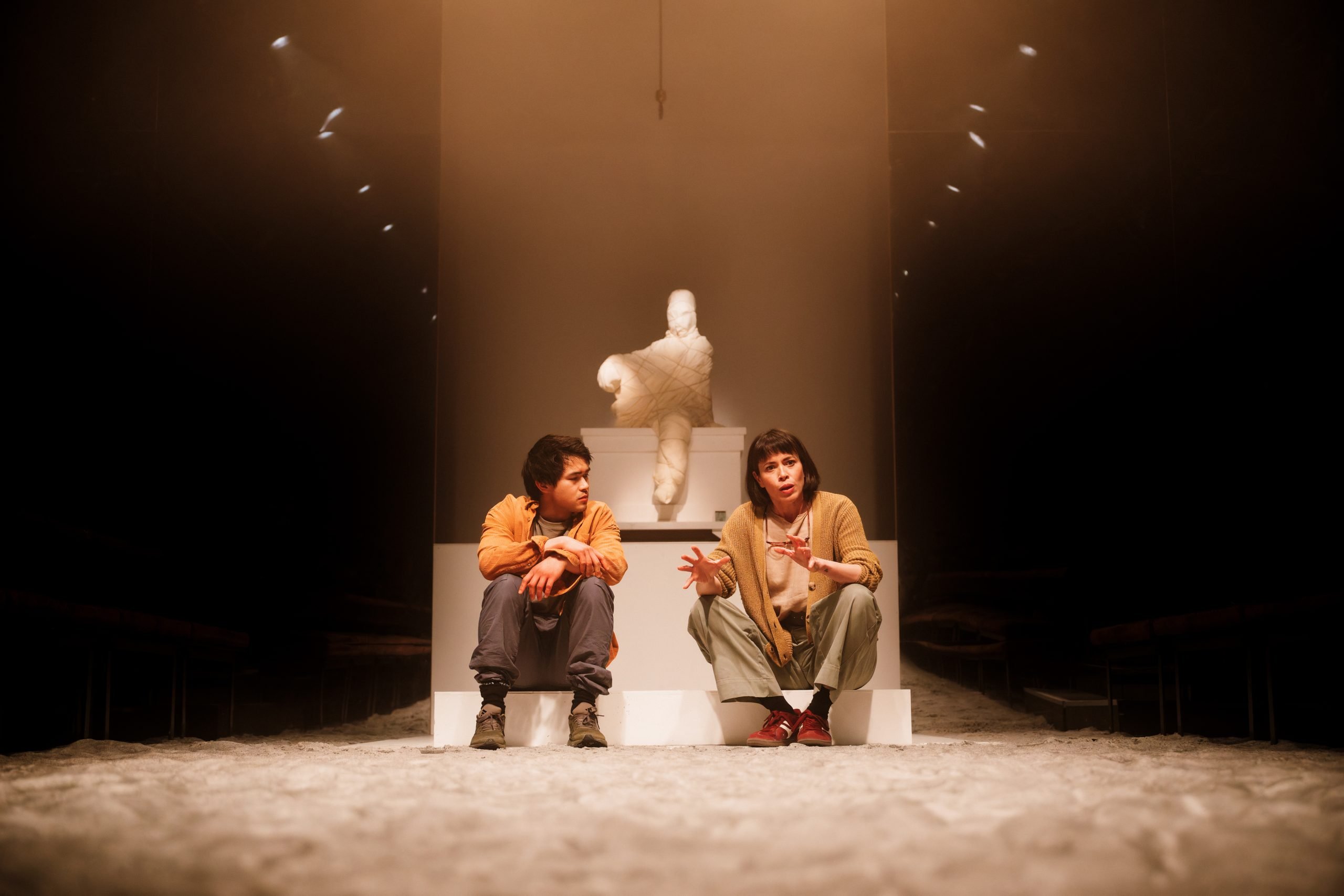
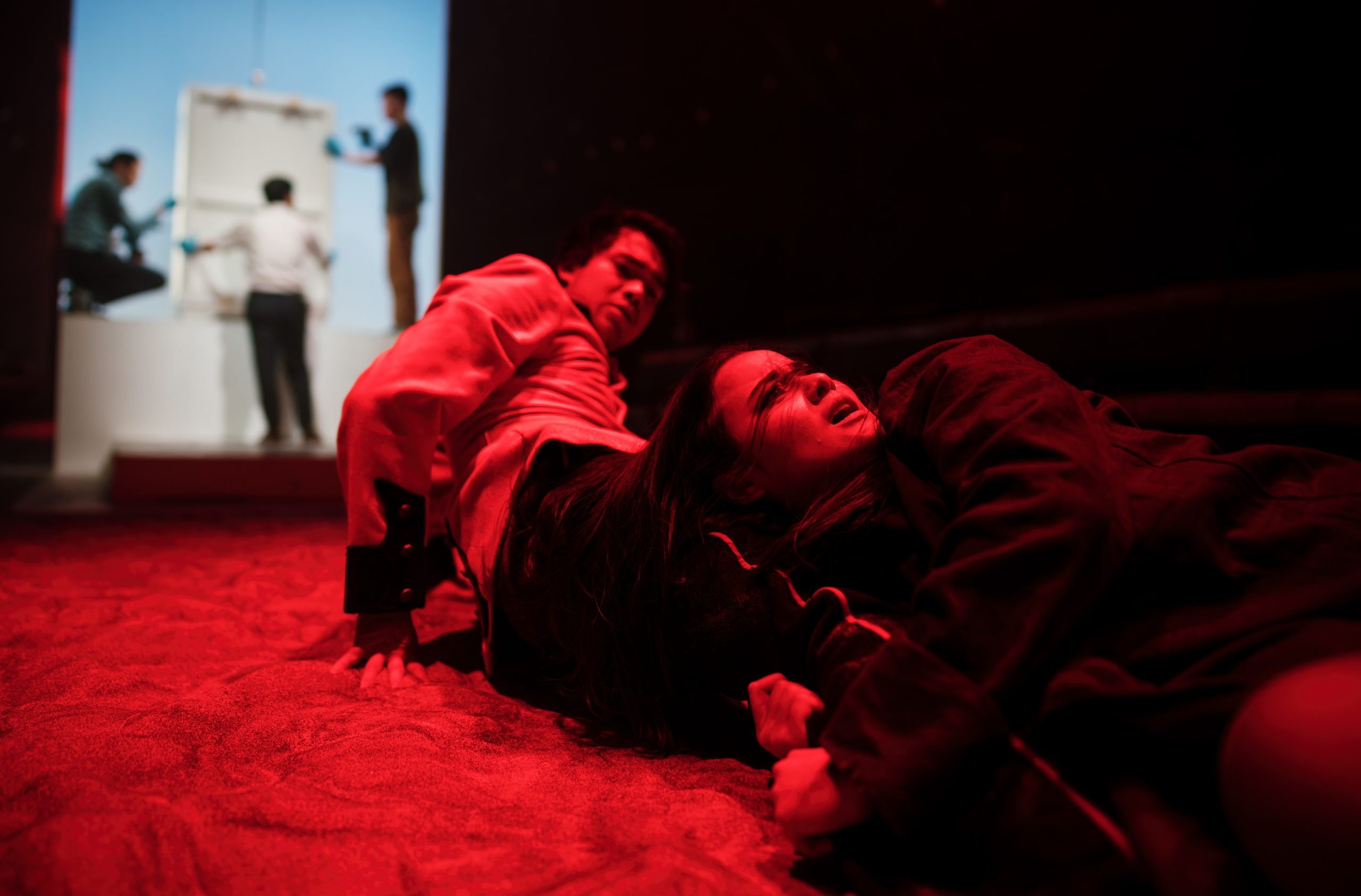


Photographs by Alex Brenner, courtesy of the Royal Court.
I was delighted to be at the preview performance of Scenes from a Repatriation as the play debuted at the Royal Court in April 2025. While I was there as Arts Reviews Editor of Law and Humanities, the performance connected to my own scholarly interest – as an academic at CREATe – in the complex and often troublesome relationship between law and repatriation. CREATe, currently core-funded by the AHRC, has hosted a number of high-profile conferences: most recently the Pre-event to the International Competition Network and the forthcoming European Copyright Society conference. Exactly one year ago, in April 2024, and following on from the centre’s relaunch in March 2024, CREATe staged an international conference about repatriation: From Scotland to the World: Repatriation and Museums – which I co-organised with Steph Scholten (Director, The Hunterian and member ICOM Executive Board), Alexander Herman (Director, Institute of Art and Law and author of The Parthenon Marbles Dispute Bloomsbury, 2025) and Andreas Giorgallis (then PhD Student, CREATe, now Research Associate, Cardiff University).


From Scotland to the World: Repatriation and Museums drew lawyers, scholars, museum professionals and representatives of claimant communities from all over the world to Kelvin Hall, Glasgow, to explore progressive museums’ current best practice in effecting repatriation. Glasgow Museums long led the way in the UK in setting such best practice in the guidance which it developed following its repatriation of the Ghost Dance Shirt to the Lakota people in the 1990s. As Duncan Dornan (then Head of Glasgow Museums) explained at the conference (Panel 1), this involved a shift in museum values: from the value of keeping objects – ‘a collective responsibility both nationally and internationally to preserve the past’ – to the acknowledgment that:
‘if museums represent our better selves, our humane values, then we have to admit the possibility that there may be other values that are more important than possession and preservation; possession in itself cannot be an absolute value taking precedence over all others.’
Glasgow Museums’ repatriation guidance issued in the 1990s – which soon became a statement of best practice in the field – recommended that repatriation should involve a consideration of 5 criteria: (i) the status of those making the request, (ii) the continuity between the community who created the object and the requester, (iii) the cultural and religious importance of the object to the community, (iv) how the artefacts were acquired by the museum (e.g. illegality or immorality) and (v) the fate of the object if returned.
Accordingly, the conference From Scotland to the World started with progressive best practice in Glasgow and Scotland, before looking outwards to the world through a series of geographical panels involving conversations between collaborating UK institutions and representatives of claimants located in the Caribbean, Australia and North America. First, a panel discussed the repatriation of the Galliwasp – a natural history specimen of a giant lizard endemic to Jamaica – by The Hunterian to the Natural History Museum of Jamaica (a return took place a few days after the conference). Secondly, a panel considered the returns by Manchester Museum of cultural heritage to the Anindilyakwa people, Australia, and finally, the conference heard about the repatriation of the 11 metre tall Ni’isjoohl Totem Pole by National Museums of Scotland to the Nisga’a people, Nass Valley, Canada (panel 6).
Steph Scholten (The Hunterian)
More than just ‘case studies’ of ‘best practice’, these conference panels – in making heard the voices of the individuals involved – also made human the repatriation debate, in staging what one speaker (Steph Scholten, Panel 1) described as the ‘journey of discovery’ where ‘collection holders, often learn as much, if not more’ than claimant communities, in the process of repatriation.
Importantly, all the speakers stressed the importance of museums making collaborative decisions in partnership with claimant communities and in the spaces in which those communities make decisions. As explained by Iain Johnston on behalf of AIATSIS, an Australian Government agency which facilitates returns to Aboriginal communities (Panel 2):
‘a fundamental tenet of our work’ with communities is about ‘custodians: people with the cultural authority to make decisions about material, and those custodians making decisions where they would typically want to make a decision.’
Linking back to the theatre: any of the speakers at the From Scotland to the World conference could have been fitting characters for theatrical portrayal, in a drama tracing their own personal stories on that ‘journey of discovery’ interwoven with institutional context and cultural meaning. For instance, at the conference we heard about the conversations which took place between curator Georgina Young (Manchester Museum) with the Anindilyakwa people on a beach on Groote Eylandt in the Northern Territory of Australia and which shaped her reflections on where cultural heritage will ‘have most meaning’, will be ‘most alive’ and most ‘at home’; as curators ‘we open ourselves to feel as well as to think… It is good to feel things; those feelings are telling you something’ (Panel 2).
Mike Rutherford (The Hunterian), Shani Roper (UWI Museum) and Elizabeth Morrison (Natural History Museum of Jamaica)
We also heard about the slightly comic email (Panel 5) received quite out of the blue by Shani Roper, curator at UWI Museum, Jamaica, from zoologist Mike Rutherford of The Hunterian: The Hunterian proposed repatriating the Galliwasp natural history specimen to Jamaica, but perhaps Jamaica could send a specimen of a mongoose (of which Jamaica is awash) in exchange?! Finally, any playwright would detect a character arc in the human story of growth in Panel 6, through the closely collaborative and mutually supportive relationship which was to develop between John Giblin and Chanté St Clair Inglis (on behalf of National Museums of Scotland) and the Nisga’a people in the process of repatriation and beyond, which contrasted with the tenor of their first meeting at the Museum; representatives of the Nisga’a people, on being presented with the Museum’s policy documents, promptly rejected those procedures and demanded repatriation within three days.
However, such conversations – the human stories that underpin repatriation best practice – are not the subject of Tan’s play. Not only does Tan pick an example where the legal framework leaves no room for museum staff legally to effect repatriation – the British Museum Act 1963 obliges the British Museum to ‘keep’ objects with very limited exceptions – but the museum personnel in the play – while claiming to be ‘some of the smartest… most progressive people in the field’ (Tan, p.35) – are far from that; they struggle to think meaningfully about how to ‘transform the museum’ (Tan, p.36) and the statue’s eventual dubious ‘repatriation’, brokered by an equally dubious Chinese entrepreneur (who is definitely not a ‘custodian’– as per the quote from Iain Johnston above) results in this sacred artefact being installed in Pudong airport, Shanghai.
For legal scholars, this fictional drama well illustrates both the problem of ‘finicky laws’ such as the British Museum Act, which impede lawful repatriation, and the importance of museums developing meaningful ethical guidance in conversation with the right community representatives, to support good repatriation practice. Indeed, that best practice guidance, as is the case going back to the first UK repatriation policy set by Glasgow Museums in the 1990s (explained above) should precisely include consideration of (i) the status of those making the request for return (e.g. no dodgy entrepreneurs) and (ii) something of the artefact’s future if returned (e.g. not installing historic and sacred artefacts in an airport).
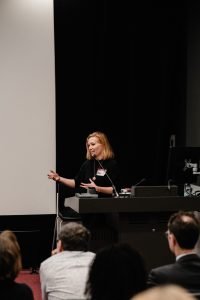
Kristin Hausler (British Institute of International and Comparative Law)
A review of Tan’s Scenes from a Repatriation, as first performed at the Royal Court, will shortly be published in Law and Humanities authored by Dr Kristin Hausler, an international lawyer (and speaker at From Scotland) who has undertaken original empirical research with claimant communities, in tracing what happens to artefacts after their repatriation. This is just one of many arts reviews that I have commissioned as Arts Reviews Editor for Law and Humanities, since joining the journal’s editorial team in Winter 2023 (which also includes Editor in Chief Prof. David Gurnham and Books Reviews Editor Prof. Matteo Nicolini). Arts reviews at Law and Humanities concern arts productions which deal with law or legal themes, and my commissions to date include the following published reviews: the novel Prima Facie by Suzie Miller (review by Prof. Sharon Cowan), the ITV drama Bates v the Post Office (review by Dr Kajsa Dinesson), the film Worth starring Michael Keaton (review by Prof. Matt Dyson), the documentary film Beltracchi: The Art of Forgery directed by Arne Birkenstock (review by Dr Grischka Petri), the exhibition Kafka: Making of an Icon at Morgan Library NYC (review by Dr Lindsay Stern), the dance drama Ruination staged by the Royal Ballet and Lost Dog Dance at the Royal Opera House (review by Dr Claudia Zichi and Dr Paola Zichi) and the visual art exhibitions Women in Revolt! at Tate Britain curated by Linsey Young (review by Dr Sophie Doherty) and Reframing Picton at National Museum Cardiff (review by Prof. James Epstein and Lillian Palmer), with a further review of the play Grenfell: in the Words of its Survivors by Gillian Slovo, National Theatre (by Dr Emma Patchett) in press.
Future reviews in the pipeline will cover arts productions staged in West End and regional theatres (Fear of 13 by Lindsey Ferrentino, Donmar Warehouse and The Marian Hotel by Caitriona Cunningham, Lyric Theatre Belfast), classical music (Voices by Max Richter), sound art (Soundings by Shane Burke and Joy Twemlow), as well as responses to Franz Kafka’s view of law/injustice in drama (Innocence by Anmol Vellani set in contemporary India which premiered at the Goethe Institut Bangalore in 2024) and visual art (Illustrations on Franz Kafka at Kunstforum Ostdeutsche Galerie Regensburg, Germany) which will feature in our 2026 Kafka Special Issue.
 At the time of writing, I am about to advertise a call on social media (details below) for a reviewer to cover a musical about Section 28 of the Local Government Act 1988 (After the Act, Royal Court, London); I am grateful to the Press Office at the Royal Court for the offer of a complimentary reviewer ticket for this show. I am also in conversation with architects about a possible future review of their highly innovative new design for a work of architecture – a collaboration between US and Scandinavian architects in which ideas about how we create space through architecture are bound up with a vision for a more liberal penal policy (and a far cry from the disciplinary power of architecture – the Panopticon – discussed by Michel Foucault in his seminal work Discipline and Punish).
Scholarly engagement with the arts lies at the heart of the law and humanities field envisioned by the journal’s founders Prof. Gary Watt and Prof. Paul Raffield (writing the first editorial in 2007) and was also an important element of the work of its former (and first) reviews editor CREATe’s Dr Marta Iljadica. In keeping with this spirit, our arts reviews, in forging new connections between original scholarship and the cultural sphere, and in individually and collectively creating a cultural record formed through a scholarly mantle, are an exciting strand of our dynamic interdisciplinary field. If you might be interested in contributing to arts reviews, whether now or in the future, or if you would like to propose an arts review, please do contact me by email; the journal Law and Humanities is very much created by its scholarly community as well as through mutually beneficial relationships with gatekeepers in the cultural sector (such as the Royal Court, the Royal Opera House, Donmar Warehouse, the Kunstforum Ostdeutsche Galerie Regensburg and playwrights like Anmol Vellani) which make our reviews possible (whether through the offer of a complimentary reviewer ticket, access to an otherwise sold-out show, a complimentary exhibition catalogue or a copy of an unpublished new playscript). At Law and Humanities, we value all these relationships. In short: I would love to hear from you!
To hear about new arts reviews, calls for reviewers and more, please do follow on social media, on Bluesky @law-and-humanities.bsky.social and @drelenacooper.bsky.social (and also on X @law_humanities and @drelena_cooper).
Elena will be speaking about arts reviews as part of this year’s annual Law and Humanities event, which is a showcase of original law and humanities scholarship exploring ‘Jane Austen’s Legal World’. The event, convened by Prof. Rebecca Probert (University of Exeter) and introduced by Prof. David Gurnham (Editor in Chief, Law and Humanities) will be held at the University of Exeter on 11 July 2025. Those interested to attend should email Prof. Probert.
Those interested to find out more about the ‘From Scotland to the World: Repatriation and Museums’ conference can access a digital resource, including recordings of most panels, here. The conference photos used in this blog are by Lukas Powroziewicz.