decorative banner for the ECS conference, featuring Am Bodice, the 9th munro in alphabetical order as photographed by Kim Traynor https://commons.wikimedia.org/wiki/File:Am_Bodach,_Glencoe.JPG

Beyond private law? The regulatory aims of copyright law

On 16 May 2025, CREATe hosted the ninth annual conference of the European Copyright Society under the theme Beyond private law? The regulatory aims of copyright law.

The 2025 event was a working conference, with four panels preparing future Opinions by the ECS. Two open discussions reflected topical issues relating to the UK’s relationship with EU law and the evolving governance of copyright in the context of AI. You can find the full programme below. The ECS conference also coincided with the 2025 CREATe Spring School: (re)Humanising Creativity.

The ECS conference was hosted with the support of the AHRC, in the Advanced Research Centre of the University of Glasgow.

16 May – Advanced Research Centre (Room 237 A + B)

Time Details Speakers
08:30 Registration
09:15 Welcome Professor Sara Carter (Vice Principal of the University of Glasgow & Head of College of Social Sciences)
Professor Claire McDiarmid (Head of the School of Law)
09:30-10:30 Panel 1: Creatives

Unwaivable right of remuneration (Arts. 17/18 CDSM directive, streaming services, AI)

Cour constitutionelle (Belgium): 13 questions to the CJEU

Prof. Séverine Dusollier (chair, Sciences Po Paris)

Prof. Bernt Hugenholtz (IViR, University of Amsterdam),

Prof. Alain Strowel (Saint-Louis University and UCLouvain)

10.30-11.30 Panel 2: Sustainability

Stacking of rights, right to repair (Allposters case)

Prof. Martin Senftleben (chair, IViR, University of Amsterdam)

Prof. Valérie-Laure Benabou (Université Paris Saclay / UVSQ)

Prof. Péter Mezei (University of Szeged)

Prof. Ole Andreas Rognstad (University of Oslo)

11.30-12.00 Tea / Coffee
12.00-13.00 Post-Brexit discussion

“Is the UK taking CJEU jurisprudence too seriously?”

Prof. Jonathan Griffiths (chair, Queen Mary, University of London)

Prof. Lionel Bently (University of Cambridge)

Prof. Estelle Derclaye (University of Nottingham)

13.00-14.00 Lunch
14.00-15.00 Panel 3: Democracy

The relationship between public-sector information, freedom of information and copyright (Public.Resource.org case)

Prof. Mireille van Eechoud (chair, IViR, University of Amsterdam)

Assoc. Prof. Martin Husovec (LSE)

Prof. Caterina Sganga (Scuola Superiore Sant’Anna, Pisa)

15.00-15.30 Tea / Coffee
15.30-16.30 Panel 4: Innovation

“Lawful access”, AI and Open source (LAION case)

Prof. Thomas Margoni (chair, CiTiP, KU Leuven)

Prof. Axel Metzger (Humboldt-Universität, Berlin)

Assoc. Prof. João Pedro Quintais (IViR, University of Amsterdam)

Prof. Tatiana Eleni Synodinou (University of Cyprus)

16.30-17.15 ECS discussion

The world according to the EU’s AI Code of Practice OR The future governance of copyright

Prof. Alexander Peukert (Goethe-Universität Frankfurt am Main)

Prof. Pamela Samuelson (UC Berkeley) in conversation with

Prof. Martin Kretschmer (chair, CREATe, University of Glasgow)

17.15 – 18.00 Reception

17 May – No. 10 Professors’ Square

Time Details
09:30-12:30 ECS Annual Meeting – by invitation only
12:30 Lunch buffet

The detailed conference programme, with the list of delegates can be downloaded here.

A report from the conference was published in GRUR International (October 2025):

Ula Furgał, Aline Iramina, Phalguni Mahapatra, Amy Thomas, Report on the European Copyright Society’s Annual Conference 2025, GRUR International, 2025; ikaf119, https://doi.org/10.1093/grurint/ikaf119

Prof. Lionel Bently

Herchel Smith Professor of Intellectual Property Law, University of Cambridge

Prof. Valérie Laure Benabou

Professor of Private Law, Université de Versailles Saint-Quentin-en-Yvelines (Paris Saclay)

Prof. Estelle Derclaye

Professor of Intellectual Property Law, Faculty of Social Sciences, University of Nottingham

Prof. Séverine Dusollier
Professor of Intellectual Property, Law School, Sciences Po Paris

Prof. Christophe Geiger
Professor of Law, LUISS Guido Carli University


Prof. Jonathan Griffiths
Professor of Intellectual Property Law, Queen Mary University of London

Prof. Bernt Hugenholtz

Professor of Information Law, Institute for Information Law (IViR), University of Amsterdam

Dr Martin Husovec

Associate Professor of Law, LSE Law School


Prof. Martin Kretschmer

Professor of Intellectual Property Law, CREATe, University of Glasgow

Thomas Margoni


Prof. Thomas Margoni

Research Professor of Intellectual Property Law, KU Leuven

Prof. Axel Metzger

Professor of Civil Law and Intellectual Property Law, Humboldt University Berlin

peter-mezei


Prof. Péter Mezei

Professor of Law, University of Szeged


Prof. Alexander Peukert

Professor of civil, commercial and information law, Goethe University Frankfurt am Main


Prof. João Pedro Quintais

Associate Professor, Institute for Information Law (IViR), University of Amsterdam


Prof. Ole-Andreas Rognstad

Professor, Department of Private Law, University of Oslo


Prof. Pamela Samuelson

Richard M. Sherman Distinguished Professor of Law, UC Berkeley Law

Prof. Martin Senftleben

Professor of Intellectual Property Law, Institute for Information Law (IViR), University of Amsterdam

Prof. Caterina Sganga

Professor of Comparative Private Law, Scuola Superiore Sant’Anna Pisa

Prof. Alain Strowel

Professor, Université Saint-Louis (Bruxelles) and UCLouvain

Prof. Tatiana Eleni Synodinou

Professor of Private and Commercial Law, University of Cyprus

Prof. Mireille van Eechoud

Professor of Information Law, Institute for Information Law (IViR), University of Amsterdam

Dates: 16-17 May 2025

The conference is supported by the AHRC. Attendance is free but places are limited.

map with directions between the two locations of the spring school

Venues:

CREATe is based on the Gilmorehill campus of the University of Glasgow, with offices in both No. 10 Professors’ Square (School of Law) and The Advanced Research Centre (ARC).

The ECS conference will take place on Friday 16 May in the ARC – Room 237AB, on the ground floor (Level 2).

The ECS annual meeting will be held on Saturday, 17 May in No. 10 Professors’ Square. The meeting is a closed event.

Please note that a more direct route between the two venues suggested by Google Maps is not currently practicable due to construction work on campus.

Travelling  to Glasgow

Glasgow can easily be reached by train, plane, bus, or by car. The University website provides a useful guide to getting to Gilmorehill campus.

Travelling to Glasgow by plane

Glasgow International Airport

  • 7 miles (11 km) west of the University, 8 miles (13 km) from the city centre
  • Bus service to the west end of Glasgow (no. 747) which stops minutes from the University with a journey time of about 30 minutes and a Glasgow Shuttle directly to the city centre
  • Direct flight connections to all major European hubs, plus North America and the Middle East. It is often better to avoid London Heathrow, connecting instead at Amsterdam Schiphol.

Edinburgh International Airport

  • 42 miles (67 km) east of the University
  • There is a cheap direct Airlink shuttle from the airport to Glasgow city centre (every 30 minutes, about 55 minutes journey time).  From many destinations, this is the best way to travel to Glasgow.
  • There are  also frequent train connections which require travel via Edinburgh city centre

Prestwick International Airport

  • 32 miles (54 km) south west of the University
  • Has its own rail station with direct trains to Glasgow Central train station (journey time about 50 minutes)
  • Bus service to Buchanan Bus Station in Glasgow city centre (journey time about 50 minutes)
  • Low cost European connections

For Brussels, the Charlesroi Airport flight connection is also worth considering, with options for Glasgow and Edinburgh.

Travelling to Glasgow by train

Glasgow has two main city-centre terminals: Central and Queen Street with intercity links to all major cities and frequent services to Edinburgh (50 minutes) and London (under 5 hours). For timetables see: www.travelinescotland.com. Thus it might be worth considering boarding the Eurostar train to London and then connecting to Glasgow.

Travelling to Glasgow by car

Glasgow is well served by motorways (M74 to England, M8 to Edinburgh, M80 to Stirling and A82 to the Highlands).

From Carlisle, Newcastle and the south, exit M74 onto the M73, joining the M8 at the Old Monkland junction. M8 exits for the University are J18 if travelling from the south, Edinburgh and the north and J19 if coming from Glasgow Airport and the west. Other main routes serving the University include Great Western Road (A82, north of campus), Clydeside Expressway (A814, south) and Byres Road (B808, west). Car parking on the University campus and surrounding area is extremely difficult.

Travelling to Glasgow by coach

Buchanan Bus Station is the main terminus for long distance coaches. For national services throughout the UK see Megabus and National Express.

Travelling around Glasgow

Glasgow has what is perhaps the simplest subway in the world: a circle that goes in both directions. The Campus and the ARC – Studio 2 are easily accessible from either the Kelvinhall or Hillhead stops.
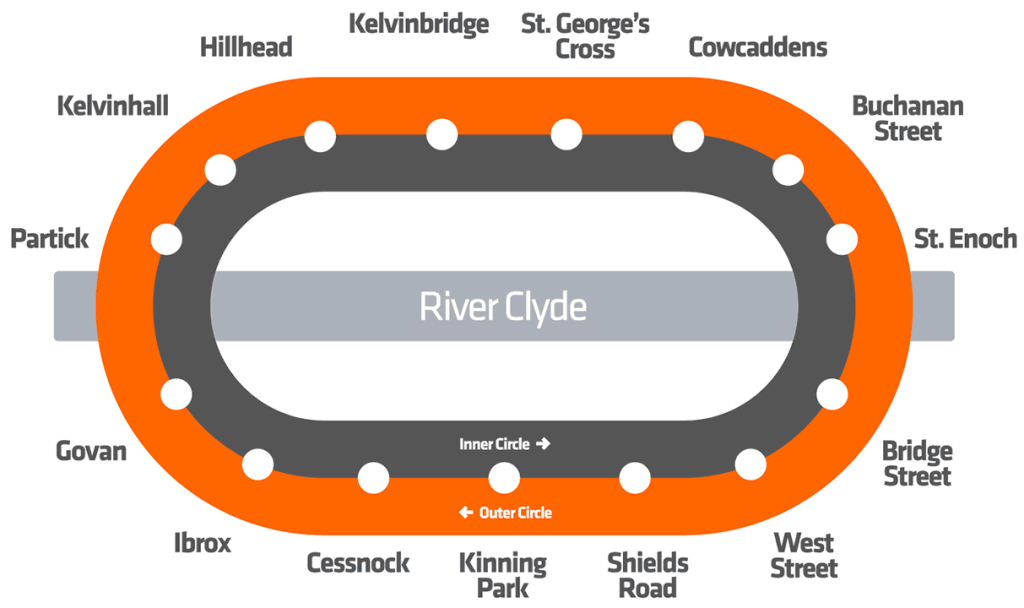
The two main train stations in the city centre are Glasgow Central Station and Glasgow Queen Street Station, which are each near a subway station: St Enoch, and Buchanan Street, respectively. To get to the University of Glasgow from each of these subway stops, jump on the Inner Circle and get off at Hillhead. It’s less than a 20 minute ride!

The University website also provides more information on public transport in Glasgow.

Staying in Glasgow

The University of Glasgow Gilmorehill campus is in the leafy West End of Glasgow. A few hotels within walking distances of campus, for various budgets are listed below:

There are also other City Centre accommodation options, such as Blytheswood Square, the Hilton, the Radisson Blu, the Hilton Doubletree, the Marriott, Premier Inn, Holiday Inn. Those will require a longer commute to the West End.

Glasgow – the friendliest city in the UK and the home of culture and music

Glasgow is the friendliest city in the UK according to CN Traveller, 2024.  We encourage you to explore it and enjoy it whilst you’re here for the conference. Glasgow means “dear green place” in Gaelic and certainly lives up to its name with over 90 parks and gardens to explore. It is also the shoppers’ paradise, with the city catering for all tastes and budgets. Glasgow is a place where music and culture are not simply confined to the four walls of venues – it’s the beating heart of the city. Please find more details to help plan you visit here.