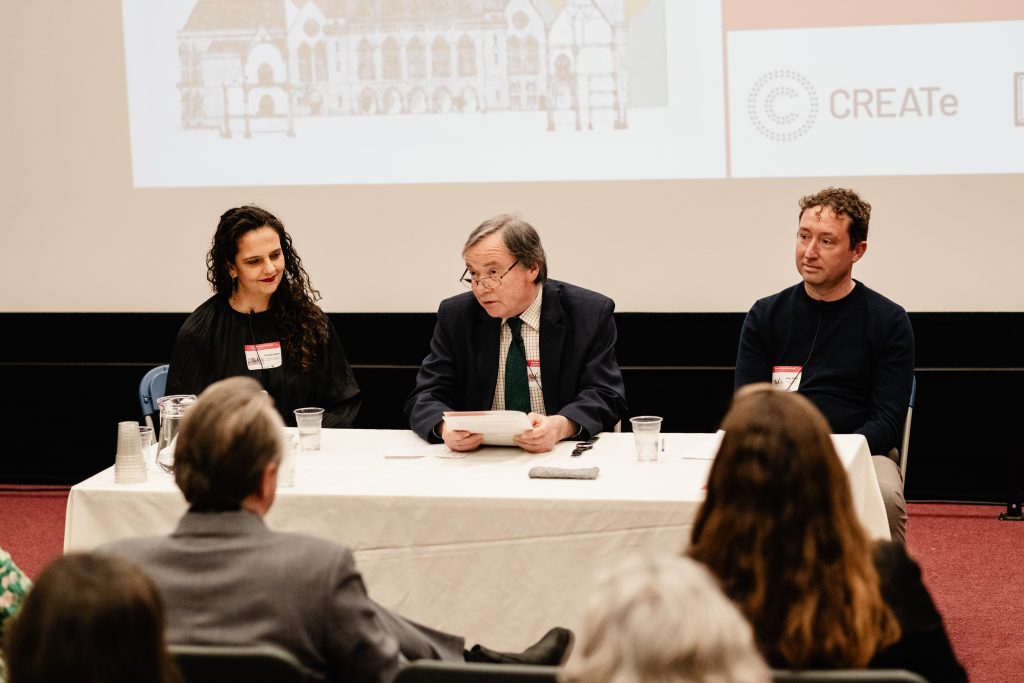
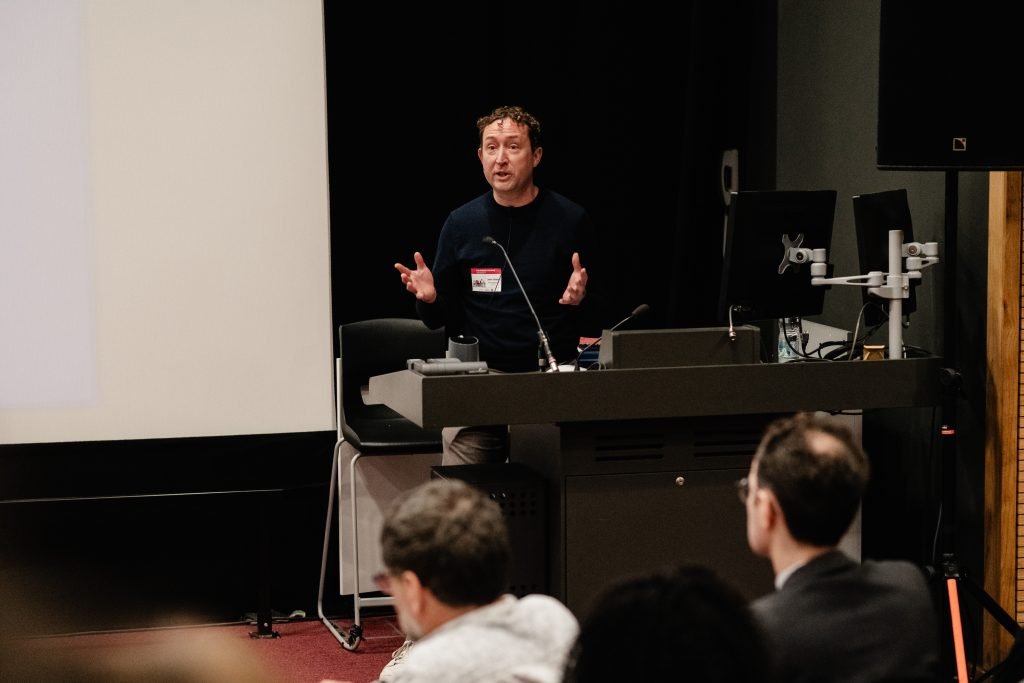
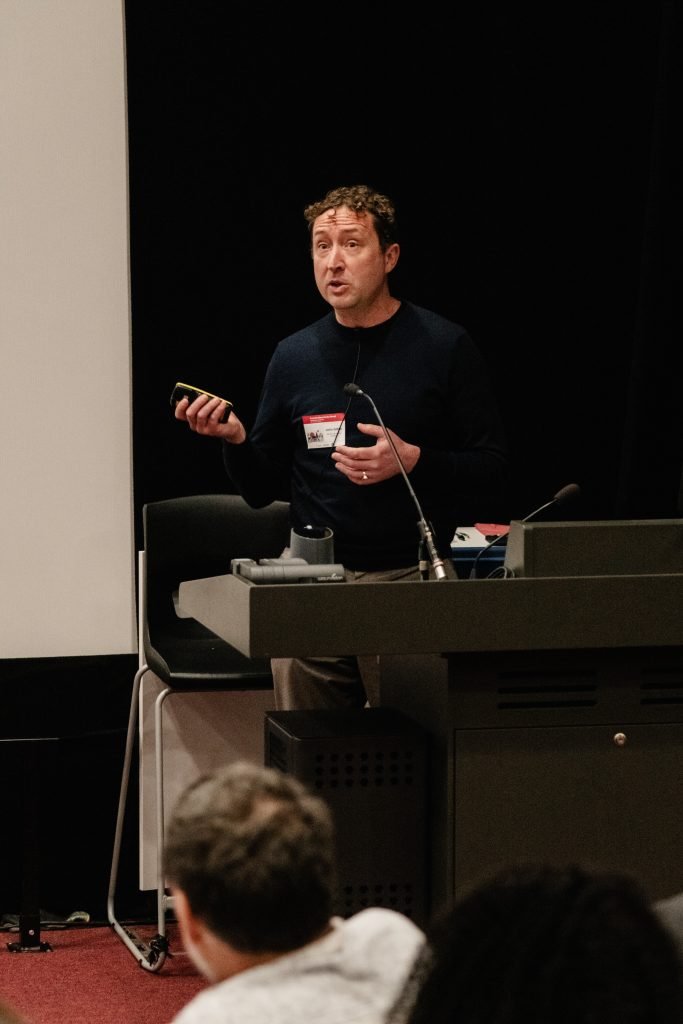
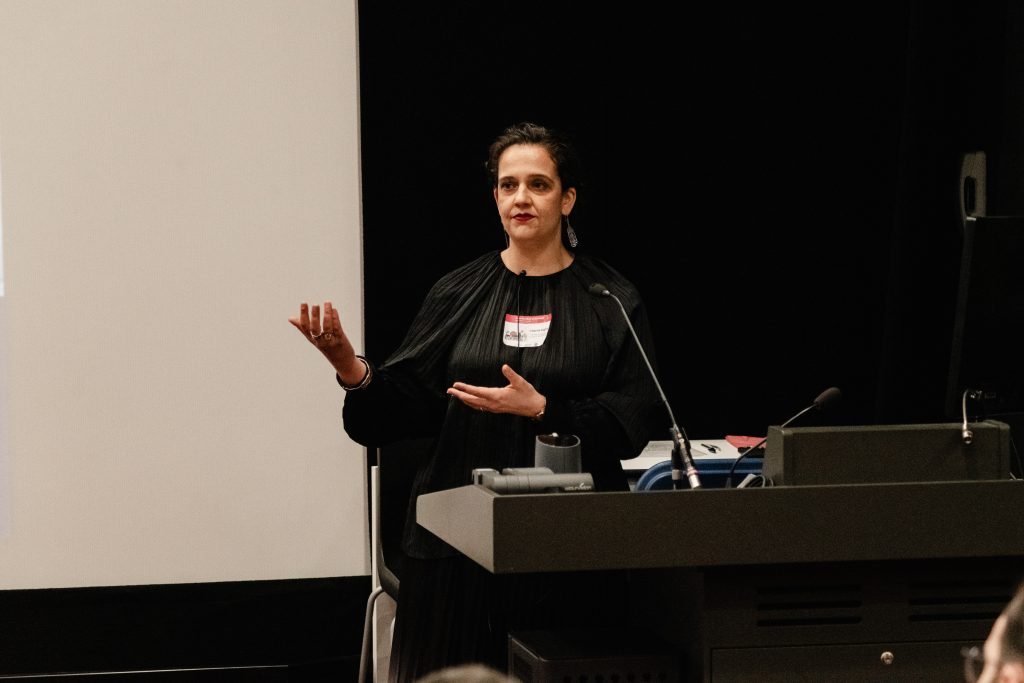
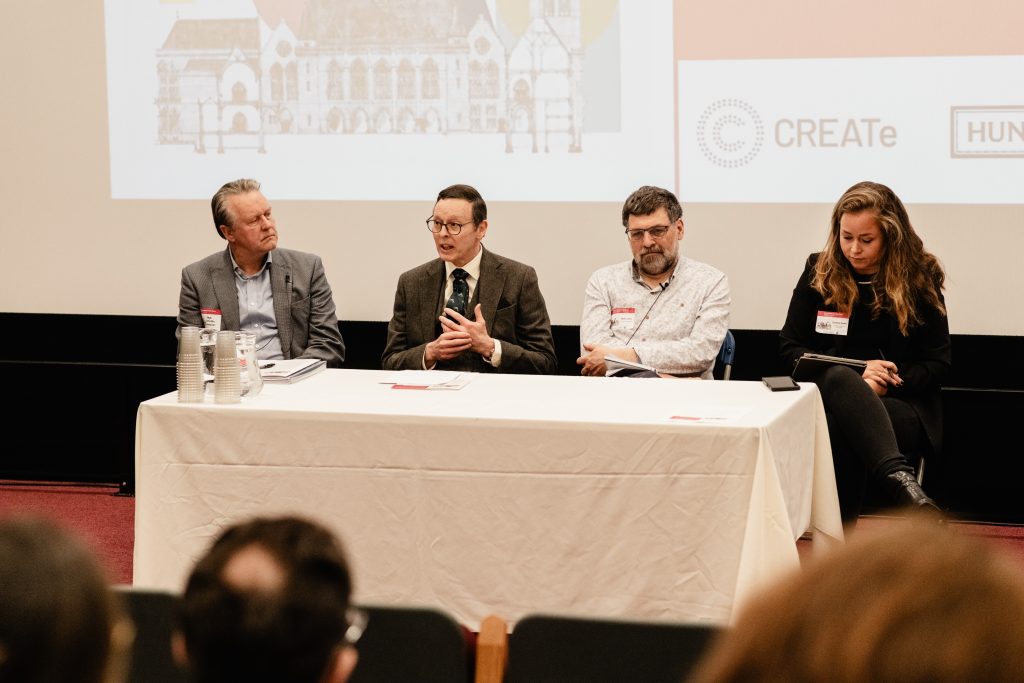
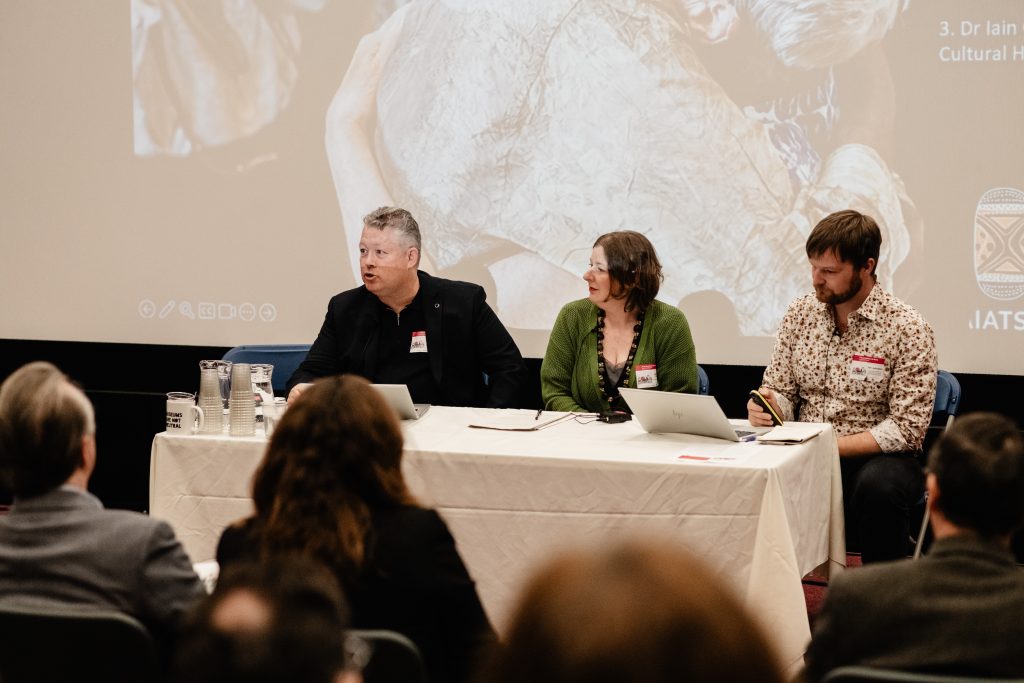
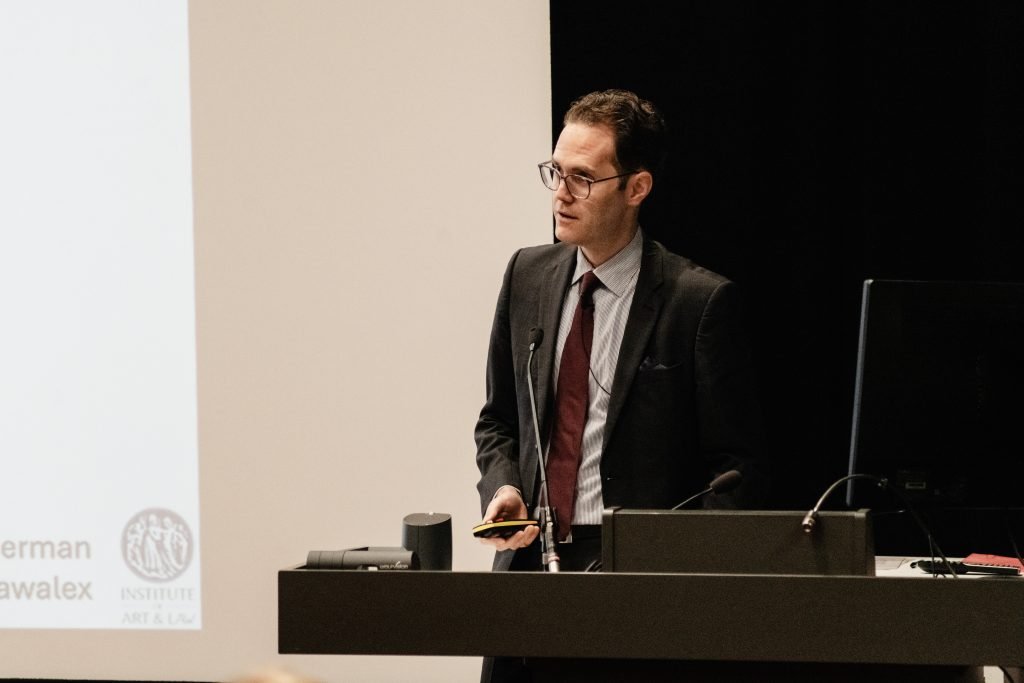
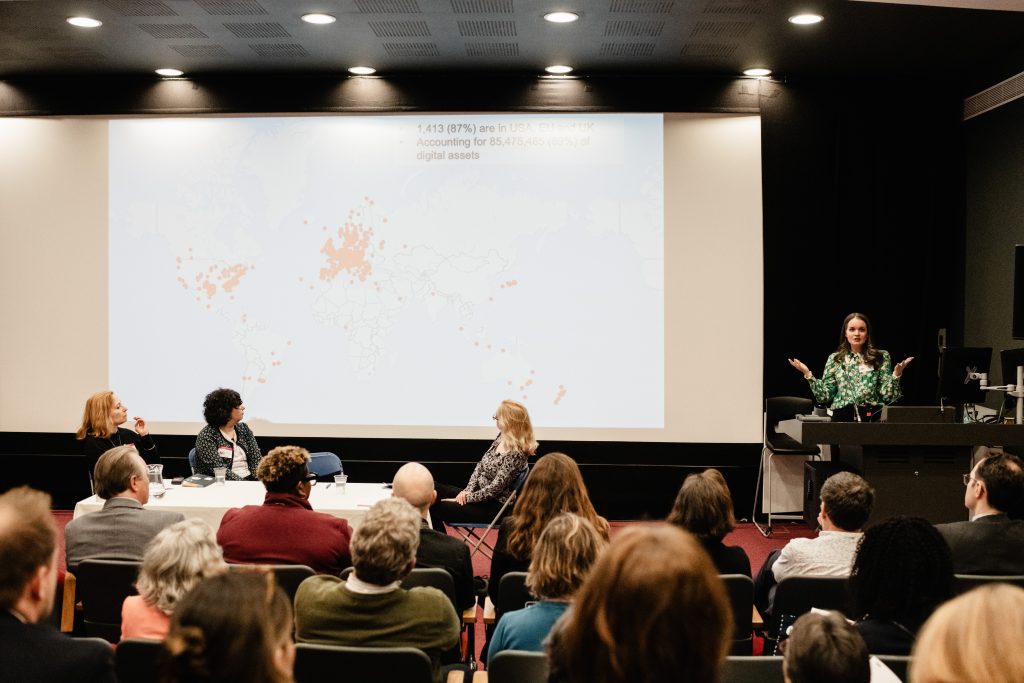
In this Event Report, CREATe’s Dr Elena Cooper explains the development of the ‘From Scotland to the World: Repatriation and Museums’ conference in collaboration with The Hunterian and the Institute of Art and Law and reflects on the event itself and its significance.
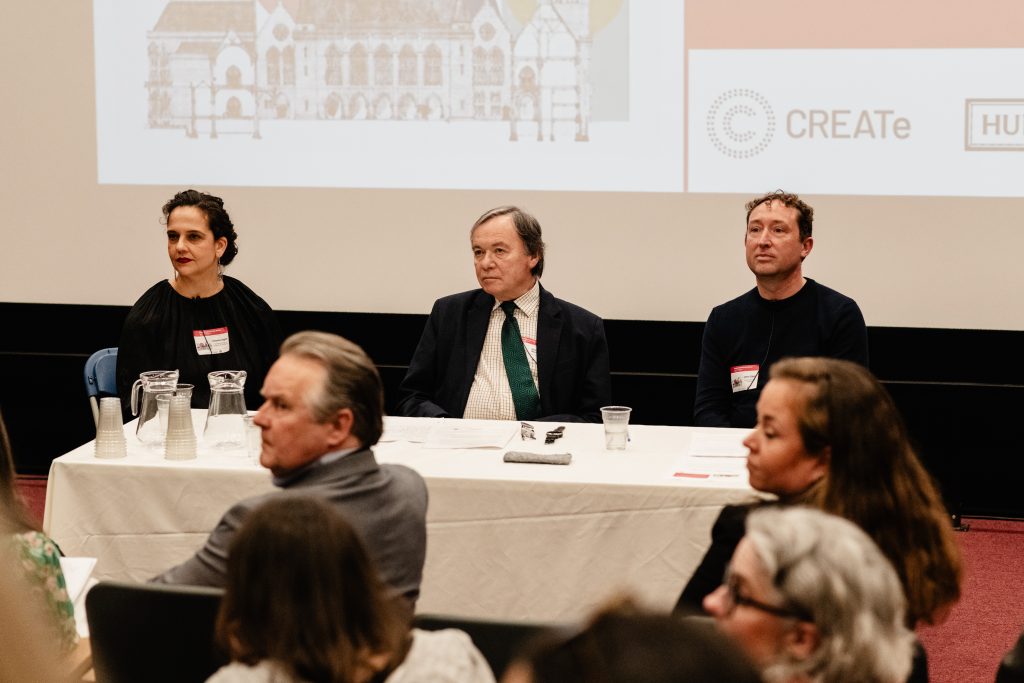
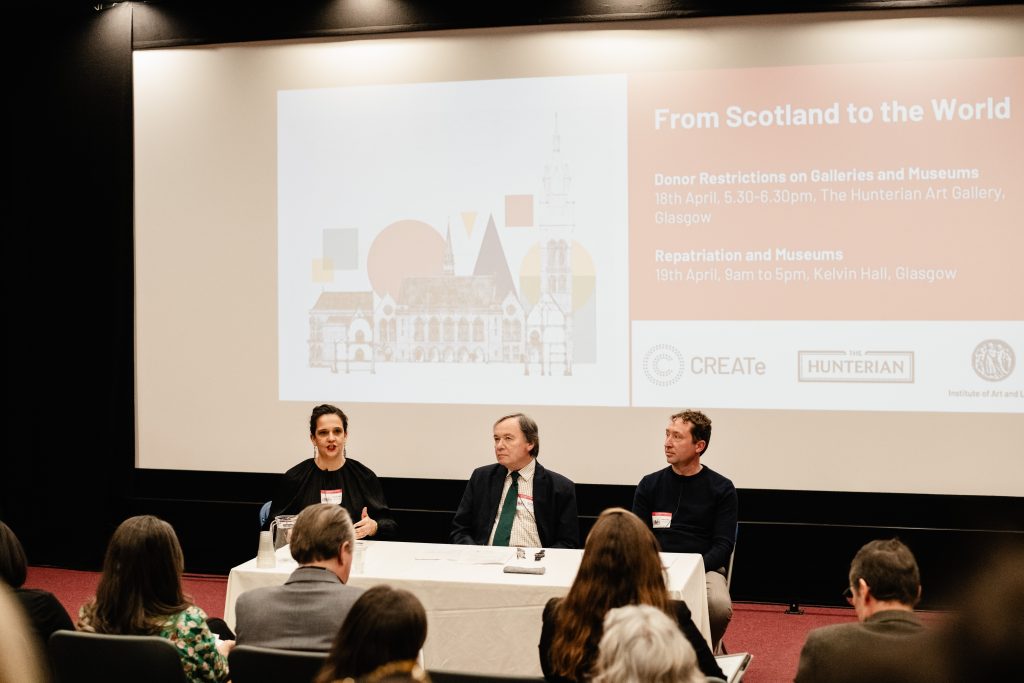
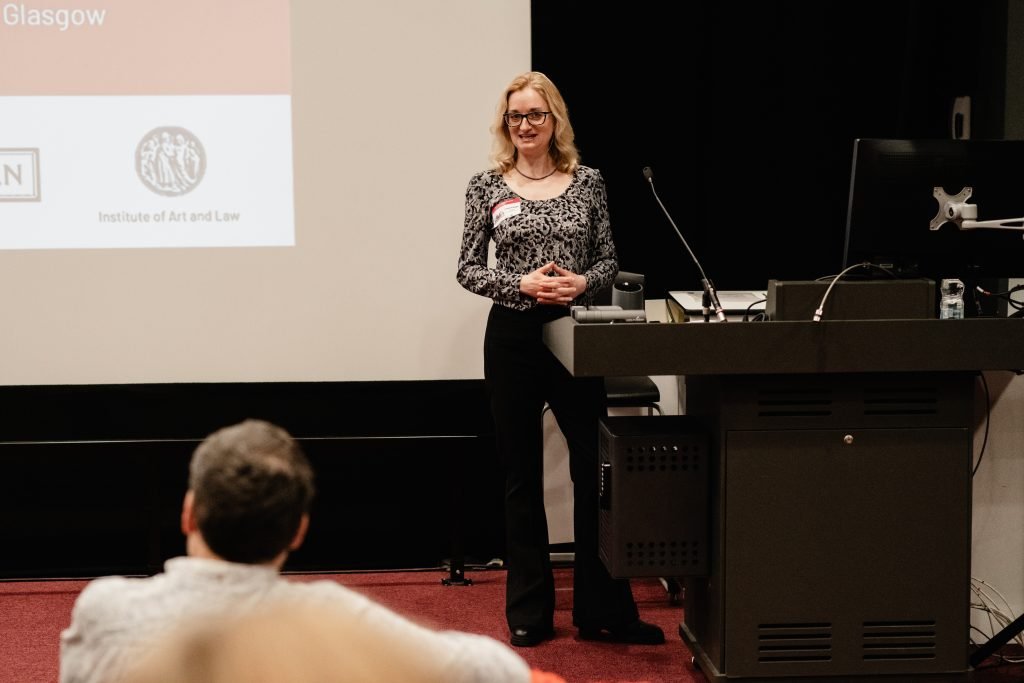
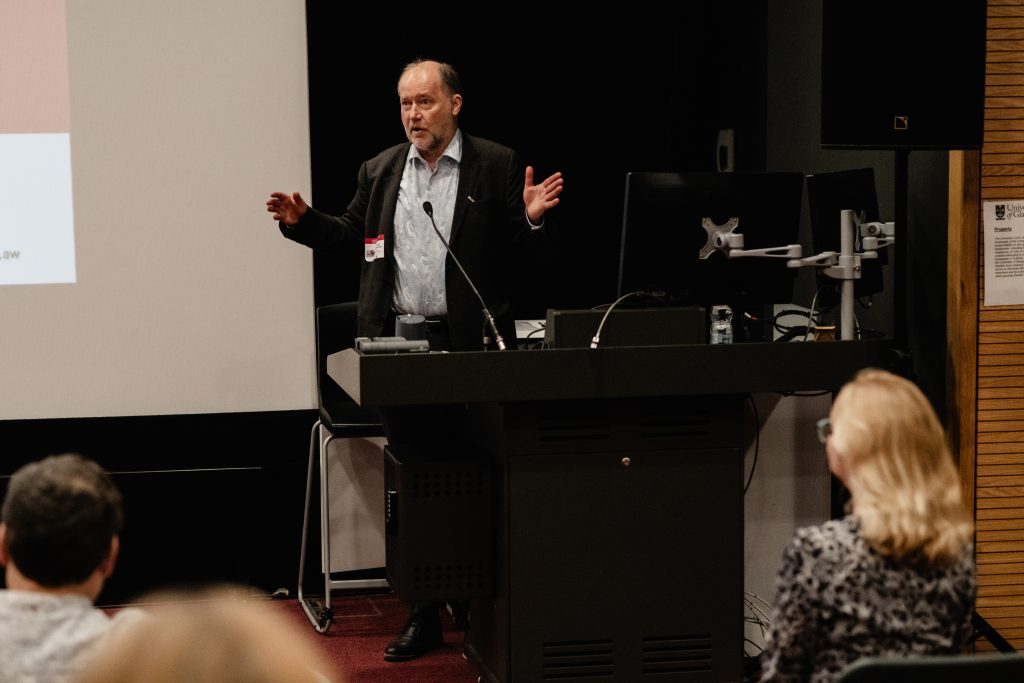
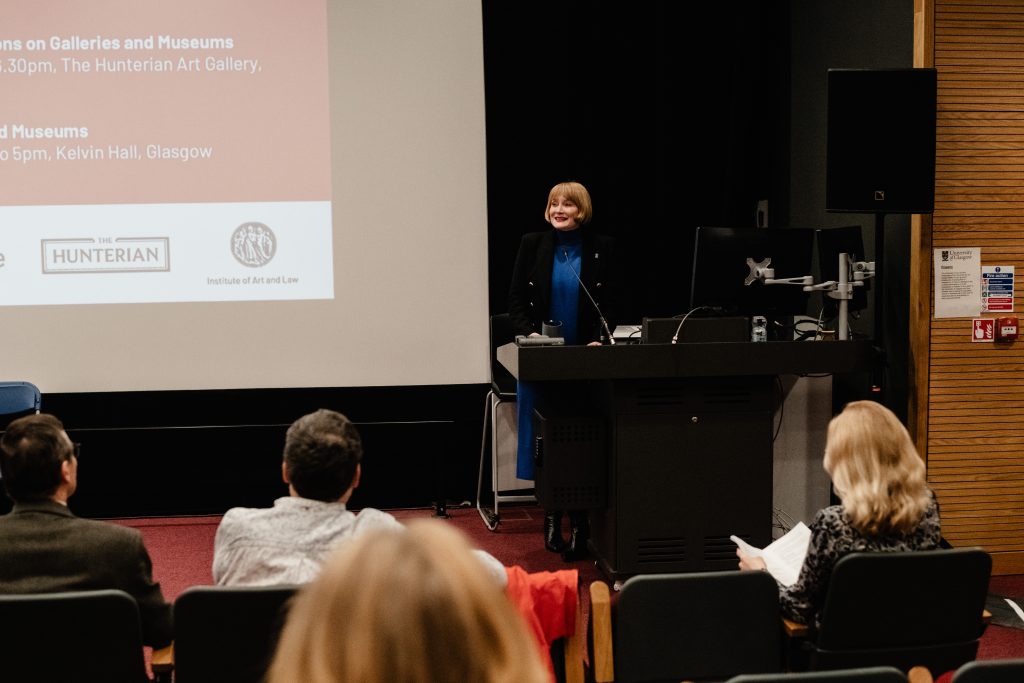
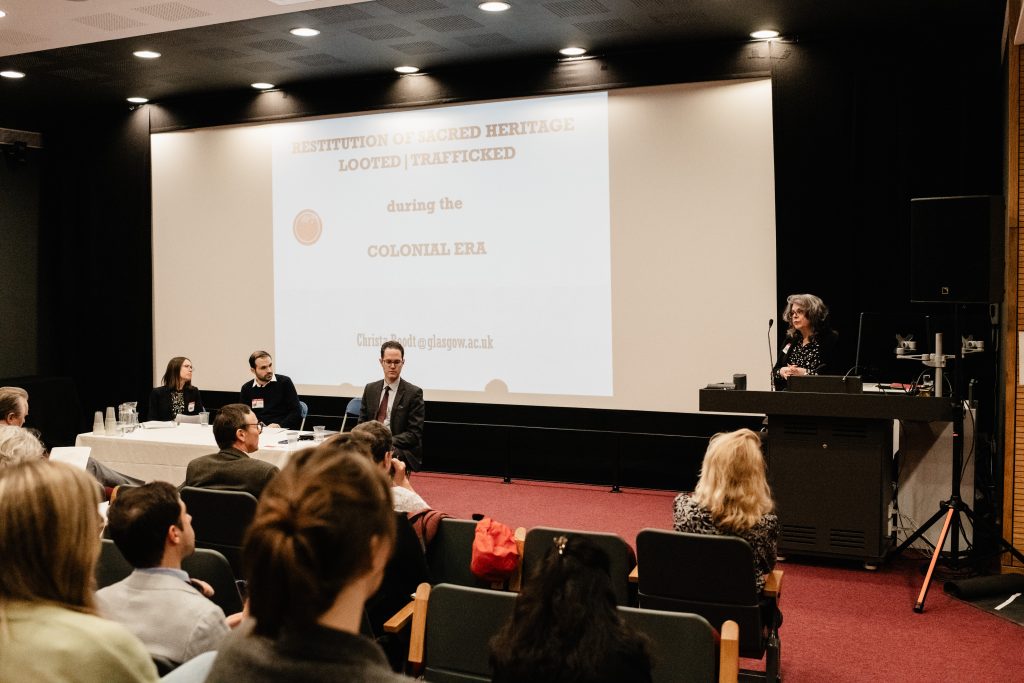
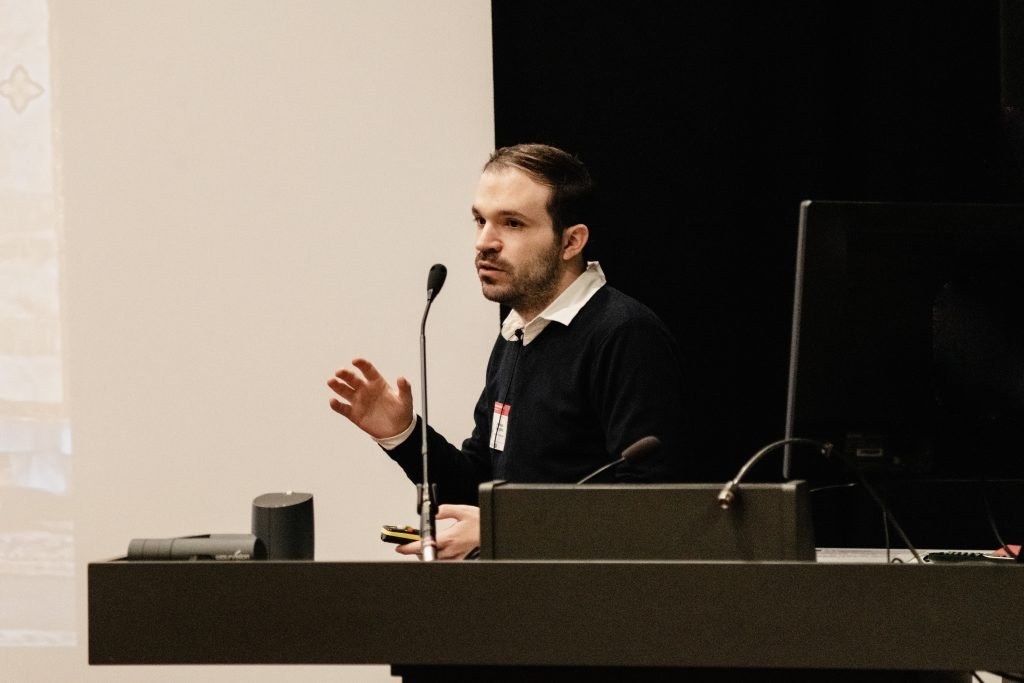
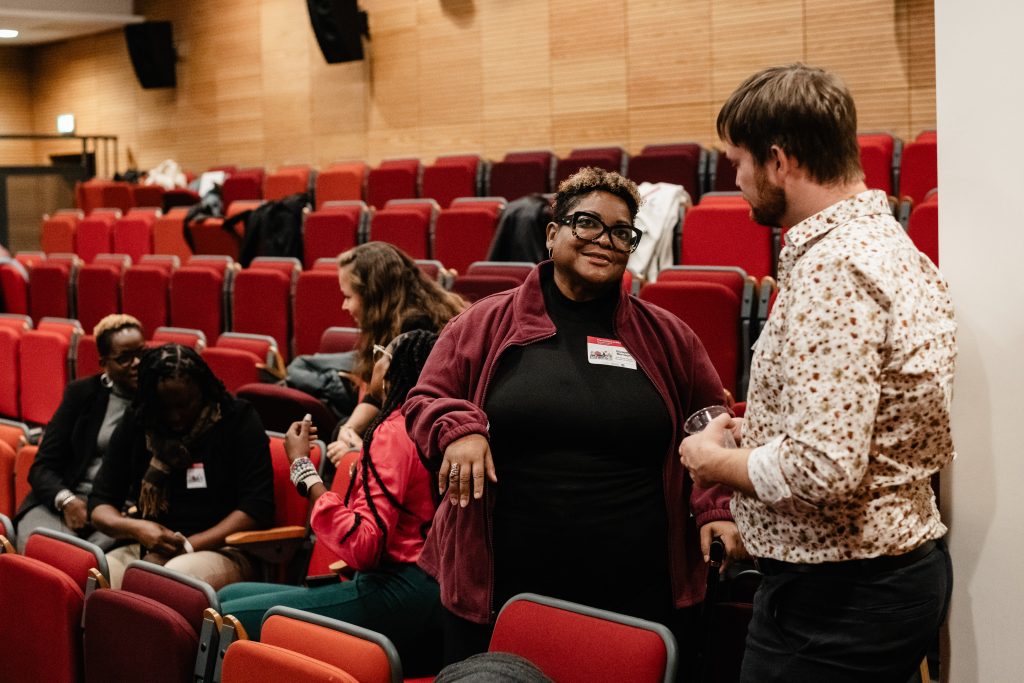
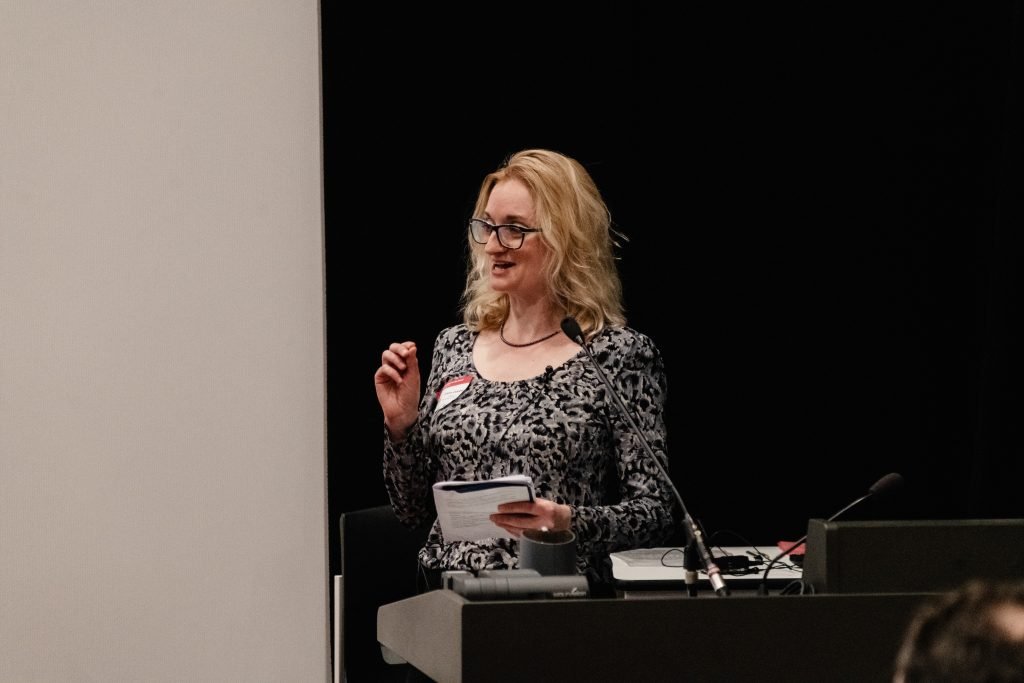
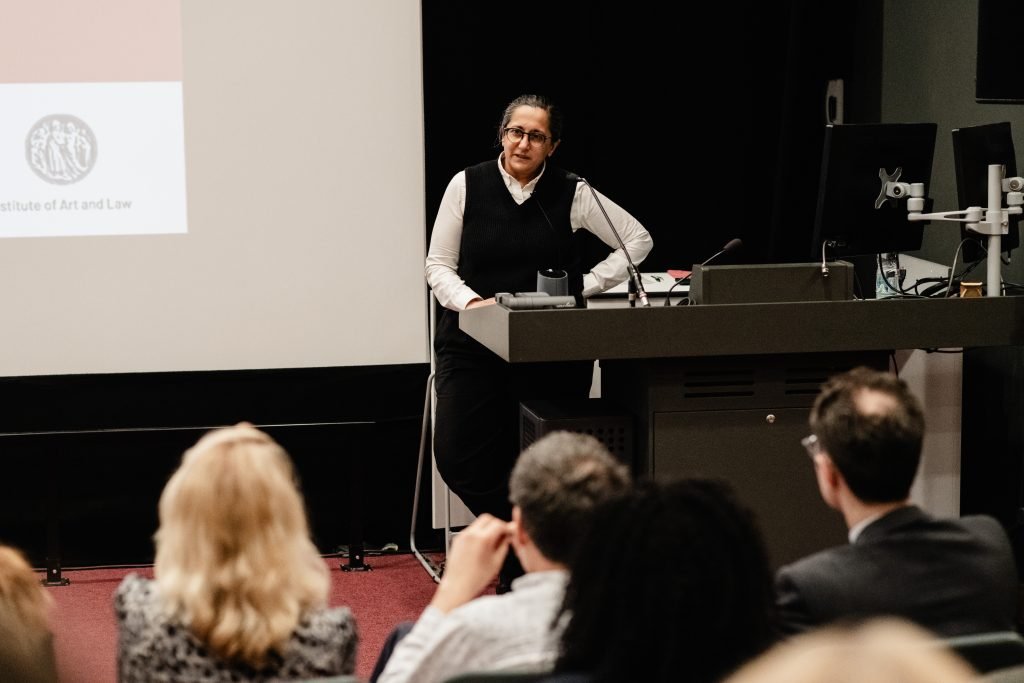
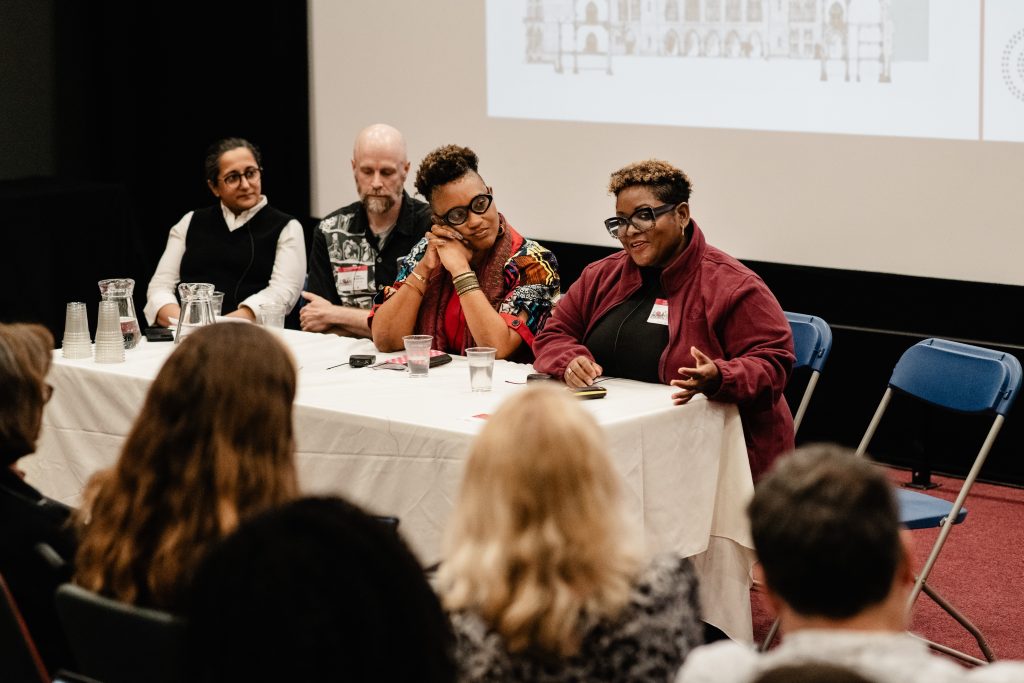
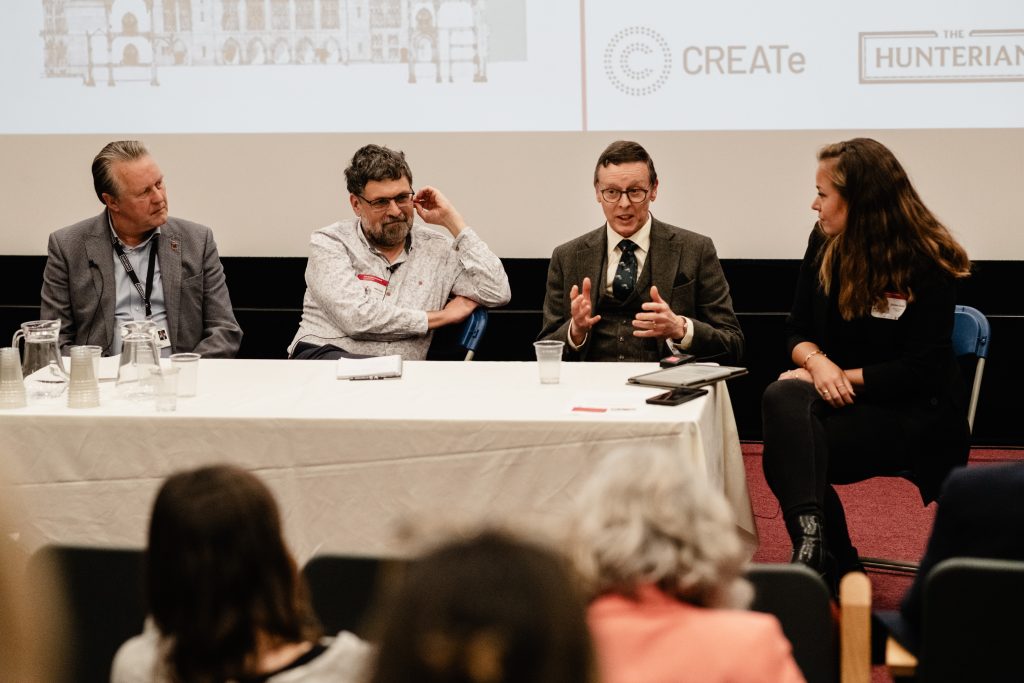
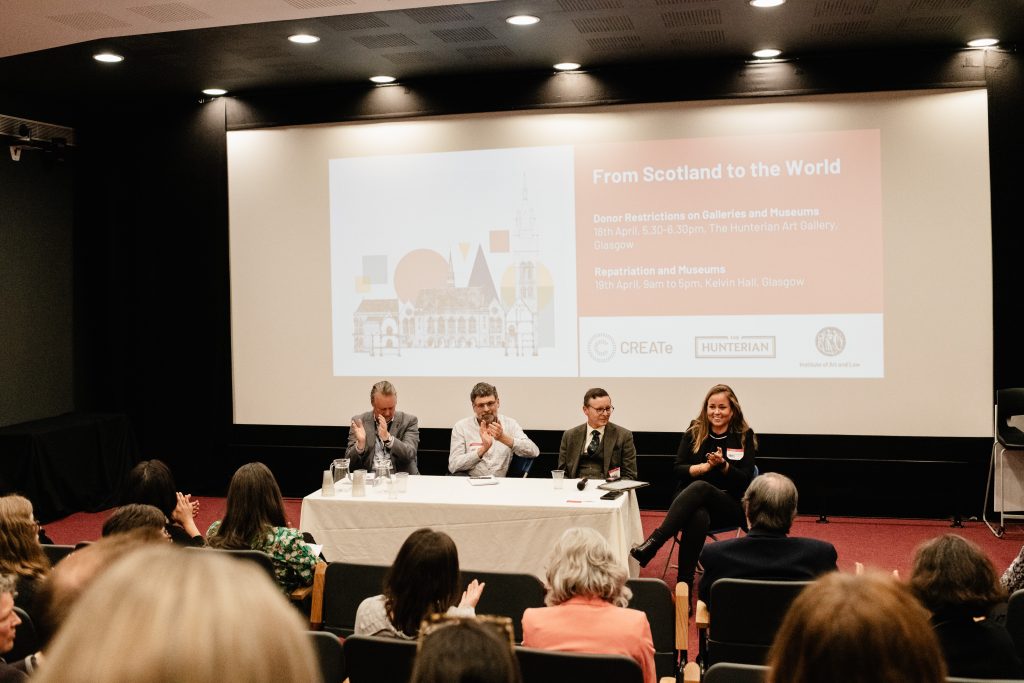
From Scotland to the World: Repatriation and Museums was a major international conference which took place in Kelvin Hall on Friday 19th April, funded by an Arts and Humanities Research Council grant awarded to CREATe (GBP 1 million, 2024-2028). Over 20 speakers from all over the globe – including leading professionals, scholars and practitioners in the fields of museums, heritage and repatriation – addressed a packed-out auditorium, comprising over 100 delegates, on diverse issues relating to the return of artefacts held by museums to communities of origin.
From Inter-Institutional Discussion to International Conference
From Scotland to the World involved ten months of inter-institutional discussion and planning, involving the close collaboration between CREATe, The Hunterian and the Institute of Art and Law (‘IAL’). The Repatriation and Museums conference was originally conceived as a small-scale add-on event to the original aim: inviting the IAL to Glasgow to celebrate the collaboration of the three institutions on a Special Issue of Art, Antiquity and Law about galleries and donor restrictions (which took place in The Hunterian Art Gallery on 18thApril 2024); if the IAL was to come to Glasgow, might we run an event about art and law together the next day?
It was clear, early in the three-way inter-institutional discussions, that repatriation of artefacts by museums to countries and communities of origin would be a fitting topic for a Glasgow event. Repatriation speaks to the present moment: as instances of repatriation grow, a topical question is how to formalise guidance that supports museum best practice. Further, repatriation is a subject with clear links to Glasgow: Glasgow Museums long led the way in the UK in setting museum best practice on repatriation (in the guidance which it developed following its repatriation of the Ghost Dance Shirt to the Lakota people in the 1990s). Hence, our conference title was From Scotland to the World: starting with progressive museums’ best practice in Scotland, we would then look outwards to the world through a series of geographical panels, involving direct conversations between collaborating UK institutions and representatives of claimants located in North America, Australia and the Caribbean.
The Conference itself: Navigating Past, Present and Future
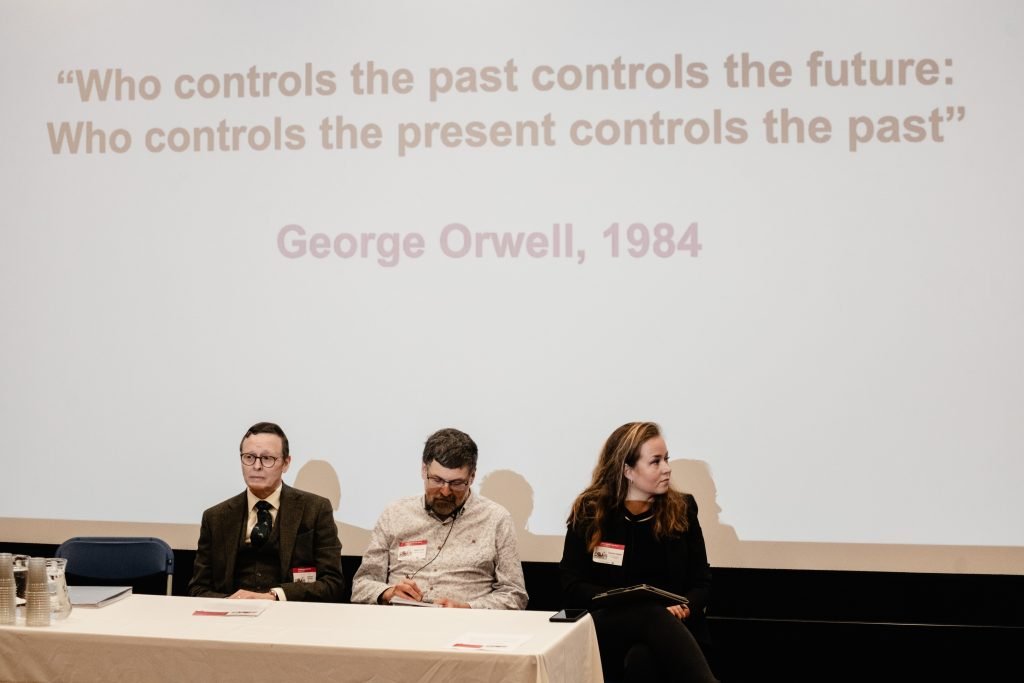
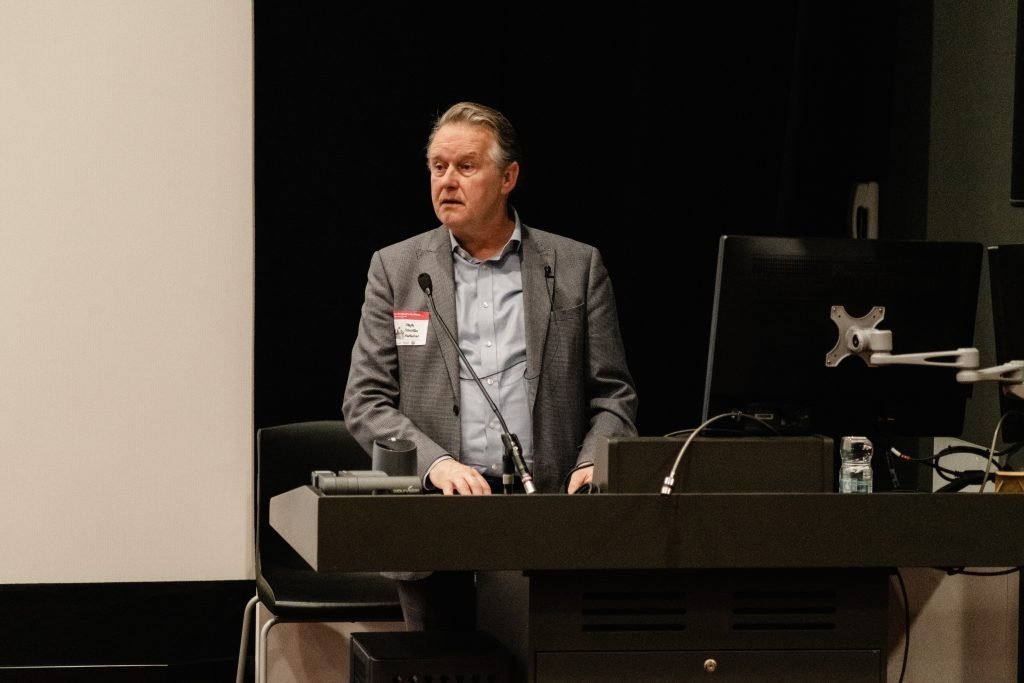
In opening the first panel, Steph Scholten of The Hunterian quoted from George Orwell’s novel Nineteen Eighty-Four: ‘Who controls the past controls the future. Who controls the present controls the past’. Scholten spoke of the ‘relevance of that quote today’: ‘historical items can be extremely powerful representations of past inequalities and past histories’ and ‘repatriation can be a powerful tool to address those inequalities and empower people in the present for the benefit of the future.’ And that capacity for repatriation to empower people, as we heard in a number of presentations, is part of a far broader societal project: of decolonising knowledge, of critically reflecting on how we tell our histories, and of uncovering new historical narratives that break with, rather than reinforce, past inequalities of power.
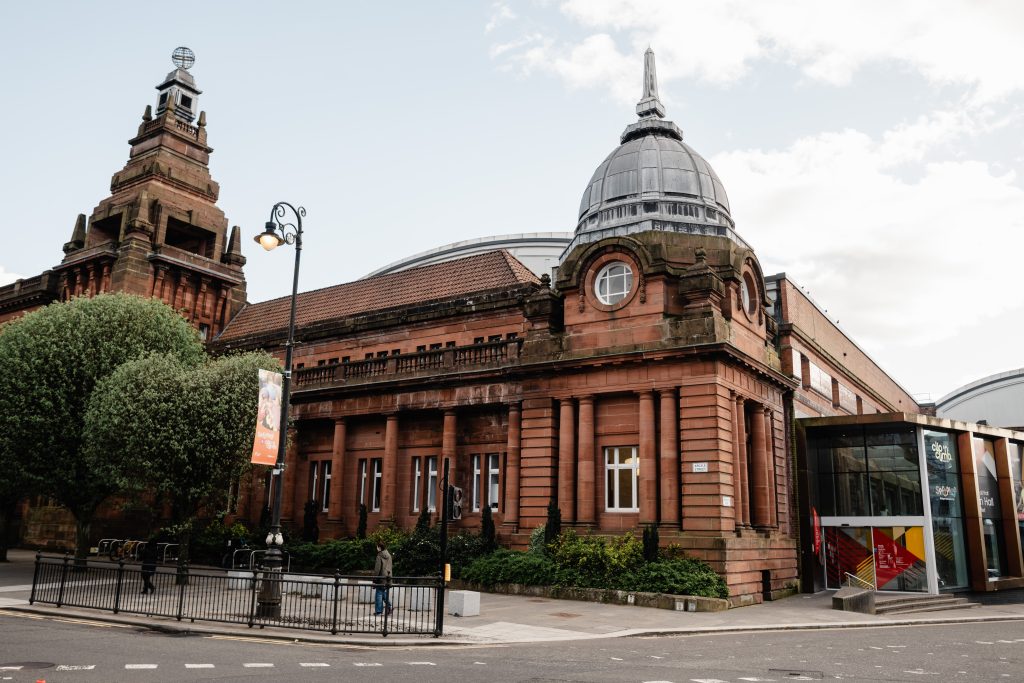
The disjunction of the values of the past and those many wish to pursue today, pervaded much of the conference. One unspoken fact was that the conference venue – Kelvin Hall – was built on the site of a very different event in 1901: the Glasgow International Exhibition, which, in the spirit of Victorian international exhibitions (starting with the Great Exhibition at Crystal Palace in 1851) was an uncritical celebration of imperial power. The debate in Kelvin Hall at From Scotland to the World conference in April 2024, could not be more different.
That contrast in values, between past and present, was captured in a powerful visual moment at the 2024 conference. Those speaking for museum practice at the National Museums of Scotland – John Giblin and Chanté St Clair Inglis – first noted the Victorian architecture of the main hall, National Museum of Scotland, Edinburgh, which intentionally emulates Crystal Palace and calls to mind the 1851 Great Exhibition’s celebration of imperial values. The audience was shown black and white photographs from the 1930s, of a huge exhibit that appears a permanent fixture in a Victorian exhibition space: the Ni’isjoohl Totem Pole (11 metres tall and weighing 1 tonne), which had been sold to the Museum in the early twentieth century, having been taken without consent from the Nisga’a people, Nass Valley (today in British Columbia, Canada). Yet, in a couple of minutes of high-speed video footage, Giblin and Inglis showed the Pole being packed up and removed from the Museum and returned by Canadian military jet to the Nisga’a people. We should and can, the message seemed to be, make different choices today.
Repatriation through a Legal Lens
But can we make different choices? This was an important point, given the conference was paid for and organised by an academic research centre – CREATe – that is part of University of Glasgow’s School of Law. Throughout the conference we heard of instances of the law standing in the way of return and supporting a value-system of the past: the value in museums preserving objects without regard to where they would have most meaning to people. The British Museum Act 1963, as we learnt from Alexander Herman (IAL Director), obliges the British Museum to ‘keep’ objects and not to dispose of them, save for limited statutory exceptions (duplicates, artefacts unfit for keeping, and following specific statutory amendments in 2004 and 2009 respectively: human remains and Nazi looted art) and in France, museum collections are inalienable (both under heritage code and as public property) with exceptions requiring special legislation, or the agreement of a long-term loan. Also, Andreas Giorgallis (PhD student, CREATe) explained how basic public international law principles of inter-temporal law (i.e. that legality is judged by the standards of the time, not those of today) and non-retroactivity (i.e. that new laws only apply to the future, not the past), in this context, enable international law frameworks to sustain past values: the ‘civilised us’ against the ‘uncivilised other’.
Interestingly, those museums that have chosen to return artefacts, have legal frameworks that are flexible to accommodate new values. Glasgow Museums, which has long taken a progressive approach to return, is run by Glasgow City Council; as a local Council, it has a wide discretion in its actions and crucially, as Duncan Dornan explained, repatriation has long been supported by its electorate: the population of Glasgow. National Museums of Scotland, while subject to legislation (the National Heritage (Scotland) Act 1985) broadly similar to the British Museum Act 1963, nevertheless can dispose of objects if approved by the Secretary of State and, importantly, following Scottish devolution, the relevant minister is in Scotland (not Westminster).
So, legal frameworks, right now, do impact directly on the space in which institutional decisions are made. But what should the role for law be in this area? Many voiced the view that this is an area for deregulation: the law and lawyers should ‘step back’, argued Alexander Herman, to let conversations happen between museums and communities in an ‘ethical space’, though always guided by internal museum procedures. Interestingly, in that ‘ethical space’, legal hierarchies relating to the binding status of legal sources are completely inverted: the ICOM Code of Ethics, that guides the ‘ethical space’ of museum practice, refers not to the rules relating to treaties – binding instruments of international law (referred to by Giorgallis – see above) – but rather to the principles enshrined in a non-binding international law instrument: the United Nations Declaration on the Rights of Indigenous People. And in an emotionally powerful speech, Georgina Young of Manchester Museum described her commitment, not just to the articles in the Declaration on repatriation, but to ‘the whole of that document… the fundamentals of indigenous rights’.
Yet, what was also clear throughout the day, is that repatriation is not an area in which legal norms/values have been the primary driver in effecting change in museum practice. As Georgina Young continued, repatriation is about so much more ‘because we open ourselves to feel as well as to think’ and it was in conversations with communities of origin – such as the Aboriginal Anindilyakwa community of Groote Eylandt, Australia – facilitated by speakers Jason Lyons and Iain Johnston of the Institute of Aboriginal and Torres Islander Studies (an Australian government agency), that Manchester Museum developed its current approach: ‘to build a case about where cultural heritage is going to have most meaning, where it will make most difference, where it is going to be most alive and most at home.’ It was, then, collaborative conversations, made ‘in the spaces where Anindilyakwa make decisions’ (Johnston) and with ‘emotion, humility, ethics and care’ (Young), that resulted in Manchester Museum expanding its practice beyond the remit of its first return (sacred objects) to include all types of cultural object.
Repatriation as a ‘journey of discovery’
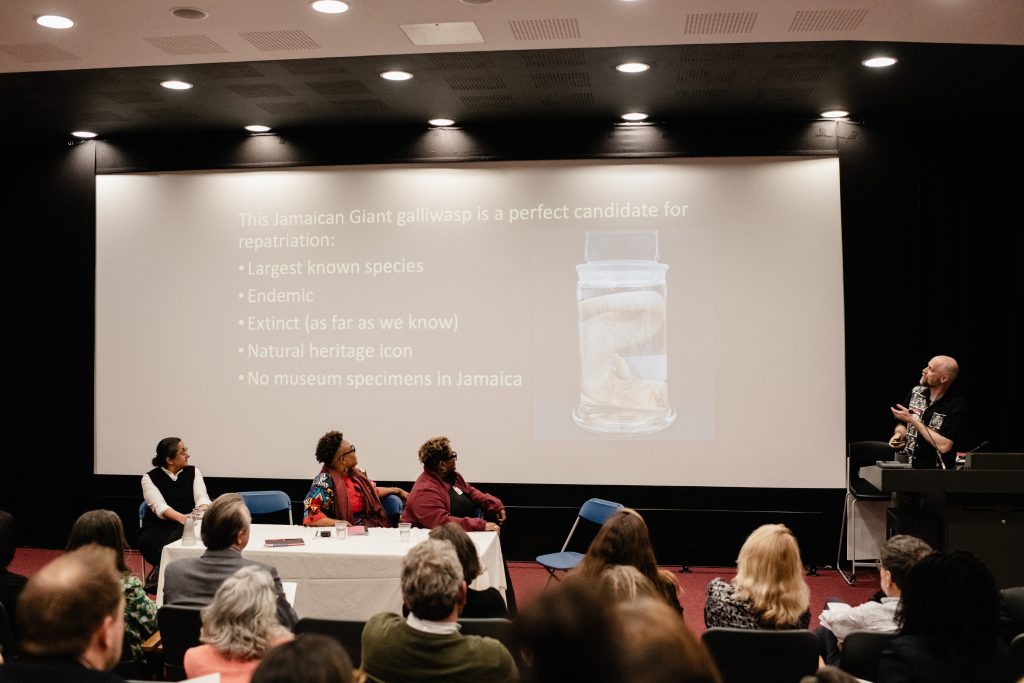
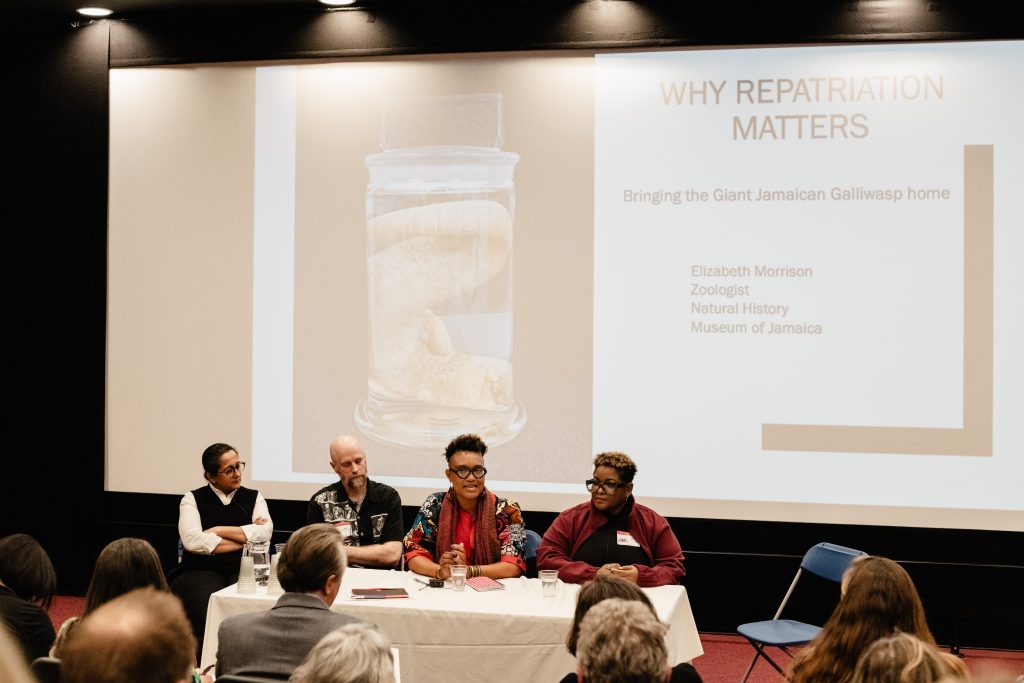
Conversations between museums and communities of origin, then, really matter. As Scholten stated, repatriation is ‘a journey of discovery’; ‘we as collection holders’ in repatriating objects, ‘often learn as much, if not more, than the people engaging with us’. And we heard about one such journey of discovery, which actually coincided with conference, the return by The Hunterian (part of the University of Glasgow) of a natural history specimen of the Jamaican giant galliwasp, a lizard endemic to the island. This process which involved six of the speakers: Shani Roper of the University of West Indies, Elizabeth Morrison of the Institute of Jamaica, Mike Rutherford, Giovanna Vitelli, and Steph Scholten of The Hunterian, and Churnjeet Mahn of University of Strathclyde. The galliwasp return was the first ever return of a natural history specimen to the Caribbean.
Interestingly, the return of the galliwasp was not instigated by a claim from a country/community of origin; as zoologist Elizabeth Morrison explained, the Institute of Jamaica had no knowledge of The Hunterian’s holding. Rather the immediate impetus for return was the Curating Discomfort exhibition at The Hunterian, where an English Professor – Churnjeet Mahn, as guest exhibition curator – was drawn to the galliwasp specimen, ‘its body contorted, held in tension against the sides of the specimen jar’, as she made curatorial choices that, in developing an ‘anti-racist pedagogical approach’, challenged existing narratives of Empire. The story of the galliwasp, then, reveals the importance of how we create knowledge at a fundamental level and that includes knowledge created through innovative interdisciplinary dialogue.
Reflecting on ‘From Scotland to the World’
Looking back at the conference from November 2024 (the launch of this online resource), it is clear that the resulting conference vastly exceeded many of the early expectations of the conference organising committee (Elena Cooper and Andreas Giorgallis from CREATe, Alexander Herman of the IAL, and Steph Scholten of The Hunterian). For instance, we assumed that we would run on a hybrid basis, so overseas speakers could join on-line. Yet, in fact, on the day, all presentations were delivered in person in Kelvin Hall (with our Australian speakers making it to Glasgow on time, despite Dubai floods delaying their transit stop-over). Further, the content of the conference – the presentations themselves – extended and went beyond the early conceptions of the From Scotland to the World theme.
First, in January 2024, as we prepared to advertise the conference, there was an important new development in Scotland: the Scottish Government formally accepted the recommendations of the Empire, Slavery and Scotland’s Museums project (or ‘ESSM’, which involved the three speakers that opened and closed our conference: Steph Scholten, Duncan Dornan and Neil Curtis). ESSM Recommendation 6 states that the Scottish Government ‘should demonstrate their support for the restitution and repatriation of looted or unethically acquired items in Scottish collections.’ As we learnt at the conference, the pro-repatriation stance of the Scottish Government is material to enabling return by Scottish museums, and that goes beyond instances where formal consent is required (e.g. the consent of the Secretary of State under the National Heritage (Scotland) Act 1985, mentioned above). As Duncan Dornan expressed at the conference, on behalf of Glasgow Museums (a local authority museum that has no express legal restrictions on disposing objects in its collections), the fact that Glasgow Council has always had the support of the Scottish Government (as well as its electorate) really mattered: ‘It would be very hard… to make [repatriation] happen where there is a will to stop it.’ Accordingly, the formal commitment of the Scottish Government, in January 2024, reinforced the importance of a Scottish perspective on repatriation practice.
Secondly, it was clear that the conference pushed the boundaries of the theme From Scotland to the World in another sense. As Georgina Young of Manchester Museum remarked – in telling the story of the repatriation by Manchester Museum of artefacts to the Aboriginal Anindilyakwa community – ‘Manchester is not in Scotland’. Young had been in Glasgow for the return of by Glasgow Museums of the Lakota Ghost Dance Shirt in the 1990s and described this as a formative experience. Yet, she presented Manchester Museum’s returns to the Anindilyakwa people as Mancunian in spirit: ‘Manchester has… pride in its radical history’ and repatriation is a ‘form of radicalism’: ‘it’s a quiet radicalism that is not about us.’ Therefore, while we might think of the approach of the British Museum – which is legally obliged to ‘keep’ objects and not dispose of them (with only very narrow exceptions – see above) – as personifying the approach to repatriation in England, the conference highlighted that the regional English position can be rather different.
Thirdly, as mentioned above, more than just a conference, From Scotland to the World coincided with the actual return of the Galliwasp, and that return itself pushed the boundaries of how we conceive of repatriation. Repatriating a natural history specimen, in going beyond established categories such as sacred objects and human remains, made clear that the scope of repatriation should also include, as Vitelli expressed, ‘aspects of the natural world that also carry meaning.’ Scholten described the repatriation of the Galliwasp as opening up ‘the whole box of Pandora’: ‘It means that everything in museums can be viewed through a colonial lens and it means everything should be considered [for repatriation] if and when that would be appropriate.’
Further, the conference highlighted numerous instances in which states play an important role in facilitating repatriation, whether in the stance of the Scottish Government (noted above), the activities of the Australian Institute of Aboriginal and Torres Islander Studies (an Australian Government agency that enables returns to Aboriginal communities), or the role of the Canadian military in physically transporting the Ni’isjoohl Totem Pole by military jet from Edinburgh to the Nisga’a people in Nass Valley. Yet, states played no role in the return of the Galliwasp. Rather, the return of the Galliwasp well illustrates the potential for interested parties – claimant communities and museums – to bypass states altogether, by developing what Shani Roper referred to as an ‘institution-to-institution’ approach. The return of the Galliwasp by The Hunterian was possible under the terms of the Memorandum of Understanding between the University of Glasgow and the University of the West Indies signed in 2019, committing the two institutions to further reparative justice. And, fitting for a conference co-hosted by a University, the MOU was rooted in the work of scholars in shifting the boundaries of knowledge: the publication of ‘Slavery, Abolition and the University of Glasgow’ in 2018 by historians Simon Newman and Stephen Mullen, which explores the University’s links to the slave trade.
Finally, the conference highlighted that repatriation does not stop with return of the physical cultural object. In thought-provoking presentations, two CREATe Fellows Pinar Oruç (University of Manchester) and Andrea Wallace (University of Exeter) unravelled the importance of also facilitating intellectual property repatriation: the ‘return’ of rights in copies of the repatriated artefacts or recordings of oral heritage. As Wallace explained: ‘Intellectual property restitution means everything that is created, that is a derivative of the act of dispossession … should go back to the community of origin.’ And, important to a conference that was funded and organised by CREATe – a research centre that is part of a School of Law and includes intellectual property law within its remit – intellectual property restitution highlights the continuing relevance of law to repatriation; complex rules on ownership of intellectual property rights, for instance, mean that legislative intervention would be required to shift the balance away from rights holders (predominantly located in former imperial nations). As Martin Kretschmer, CREATe Director, stated in the discussion following the closing panel: ‘For the material object, it really is not a legal question – you need to have a process and a conversation. Restitution or repatriation will work under the right conditions of trust; but from the intellectual property perspective, it doesn’t work, it doesn’t work at all; the process will not end by handing over the object. Something more needs to be formalised, an intervention that deserves much further thought.’