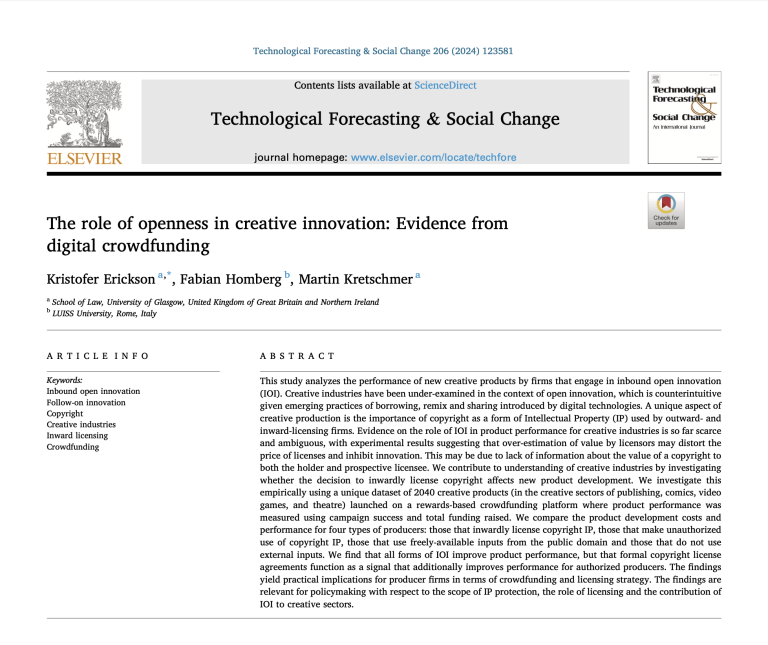


Published in the September issue of Technological Forecasting and Social Change, a new study by Kristofer Erickson, Fabian Homberg and Martin Kretschmer tracks the success of creative products on Kickstarter that borrow inspiration from external sources. Termed ‘inbound open innovation’ in management scholarship, this phenomenon has been under-studied in creative industries where copyright is the main form of intellectual property. Firms and innovators can license copyright-protected inputs from each other, or they can freely borrow from expressions in the public domain. We study both types of borrowing and find that they carry significant advantages for creative producers on Kickstarter, the largest rewards-based crowdfunding platform.
10 years in the making, this paper was initiated in 2014 as part of an ESRC-funded study to assess the value of the public domain. We studied all creative products launched in specific categories on Kickstarter over a 3-month period. We collected variables related to the project team, the amount of funding requested, the amount of funding received, and importantly, whether the project borrowed from an existing creative work. With help from CREATe data developer Felix Rodriguez Perez, we re-visited the dataset of 2,040 products in 2023 to ascertain the ultimate outcome of projects after their crowdfunding campaign ended. These new data provide rich insight into the fortunes of creative entrepreneurs in the intervening 10 years. Some projects fizzled out and failed to deliver to backers. Others went on to multi-product success, with sequels and even commercial releases beyond Kickstarter. Our study finds that borrowing from an external IP source increases the odds of funding success as well as the likelihood of eventual delivery to backers.
The crowdfunding platform offers several advantages for studying the costs and benefits of creative borrowing. Because the rules of Kickstater require product campaigns to raise the full amount of funding requested (or receive nothing at all), producers have a strong incentive to accurately represent the best estimate of production costs. We exploit this feature to gain insight into the estimated production budgets for projects that inwardly license, as well as those that don’t, providing insight into real-world costs of copyright licensing. By all measures we observed, inward licensing from copyright or borrowing from the public domain are both winning strategies on Kickstarter. Both types of follow-on products outperformed original products by a statistically significant margin.
Findings from the study are relevant to law and innovation scholarship as well as management practice. First, we contribute new insight to copyright theory by demonstrating how a copyright licence can operate as a signal to potential consumers of a creative good. Inward licensing of copyright was a signal to potential backers that producers would eventually deliver products. Second, our study shows that open innovation using inputs from the public domain enhances product performance. There does not appear to be a dilution or “snob” effect from over-use of public domain expressions, compared to original products.
There are a number of promising research directions for future work. We hope that others will take up the study of follow-on innovation in crowdfunding markets. In particular, trade mark and design right remain under-examined categories. There is other rich data to exploit as well – crowdfunding platforms not only showcase products but also enable 2-way communication between producers and consumers. The intensity of co-creation with users could be studied by comparing communication patterns of producers.
The published paper is open access and can be downloaded below.