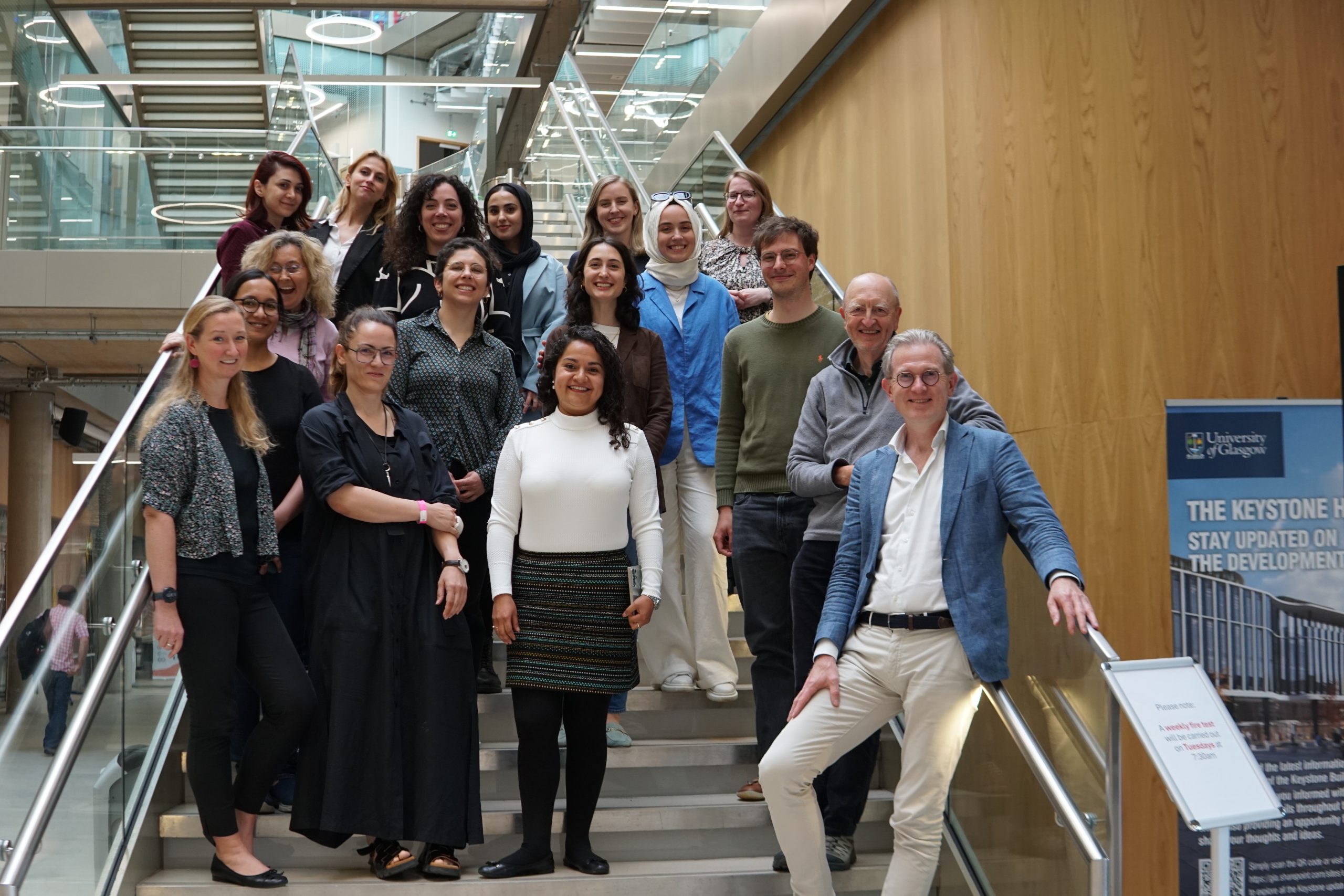


Blog post by Francesca Rotolo, PhD, Marie Sklodowska-Curie Postdoctoral Research Fellow, Ca’ Foscari University of Venice.
As visiting scholar at CREATe in May 2025, Francesca took part in the spring school as an observer. In this blog post, Francesca shares her impressions and observations of the sessions she attended.
The 2025 edition of the CREATe Spring School was hosted at the University of Glasgow and its Advanced Research Centre (ARC) – a five-storey building that houses the CREATe Research Centre, which, for researchers like me visiting for the first time, truly feels like a fairy tale. It’s a vibrant hub, buzzing with daily conferences, workshops, and events across more than 60 disciplines, such as law, music, film and television studies, and chemistry.
Now in its second year, the Spring School — held from 15 to 20 May — was organised in collaboration with reCreating Europe and featured the annual conference of the European Copyright Society on 16 May.
Designed for doctoral and advanced master’s students, early-career researchers, industry professionals, and policymakers engaged in the cultural and creative industries, this year’s edition brought together participants from around the globe — including Italy, the UK, Austria, Bulgaria, Turkey… and even Mexico!
Over four intensive days, participants engaged with leading voices in copyright, competition, and tech regulation in cultural domain. This year’s Spring School centred on the theme of (re)Humanising Creativity, examining the evolving relationship between human creative expression and emerging technologies. The programme was expertly curated by Magali Eben and Ula Furgał, who not only opened and closed the event but also encouraged us to take our careers (and hiking skills) to new heights. Together, they represented in this occasion the dual focus of CREATe: creativity and competition law.
Day One
The first day of the Spring School opened with brilliant lectures by Péter Mezei and Caterina Sganga, followed by a panel discussion hosted by the European Copyright Society, featuring Valérie-Laure Benabou, Lionel Bently, Séverine Dusollier, Bernt Hugenholtz, Thomas Margoni, and Martin Senftleben.
Péter Mezei’s talk, “Copyright in an Immersive Virtual World”, focused on the legal dimensions of the Metaverse(s), offering a timely reminder of the fast pace of technological evolution and how legal discourse tries to follow the latest technological trends. He noted how topics like NFTs, once dominant in scholarly and industry conversations, have been quickly overtaken by debates surrounding AI. Mezei emphasized that the Metaverse represents a layered digital reality that blends elements of social media, online gaming, and augmented and virtual realities. His lecture explored the intellectual property implications of it, arguing that the Metaverse does not require new copyright regulations. Instead, it can—and should—be governed by the existing legal framework and case law. That said, targeted reflection is needed when it comes to issues of liability, localization of IP infringements in virtual environments and assessment on how each individual economic and moral right may be affected.
In her talk, “Contracting Creativity According to the CDSM”, Caterina Sganga revisited Articles 18–22 of the CDSM Directive, focusing on the contractual dimension of authors’ and performers’ rights. She offered a compelling overview of how copyright law has evolved through what can be identified as three key moments: an initial phase of increasing industrialization, marked by the expansion of related rights; a second phase shaped by the rise of digital platforms and the resulting platformization of the creative economy; and a third, current phase defined by the advent of text and data mining (TDM) and artificial intelligence. Throughout this evolution, Sganga pointed out, the system has had to contend with a complex mix of persistent, unresolved issues, older problems taking on new forms, and entirely novel challenges introduced by emerging technologies. Her lecture moved from a comparative overview of how different national systems approached copyright contract law before the CDSM, to a critical reading of Chapter III of the Directive—viewed as an ambitious yet cautious attempt to harmonise the field. She finally reflected on the tension between innovation and conservatism embedded in the Directive’s provisions.
After a lunch flavoured with Scottish bread and sustained by an abundance of coffee, the afternoon resumed with a panel discussion by the European Copyright Society, this time focusing on “AI and creators’ remuneration”.
The panel explored a number of complex and pressing issues surrounding fair compensation for creators in the age of generative AI, including the crucial role of collective management organisations (CMOs) and the value of collective bargaining as tools for securing creators’ rights and ensuring a more balanced distribution of value in the market. The discussion also underscored that in the current landscape of mass content production, the individuality of authorship—of “expressing one’s personality”—is increasingly being sidelined. The panel also questioned whether copyright is the right tool to support creators in this new context.
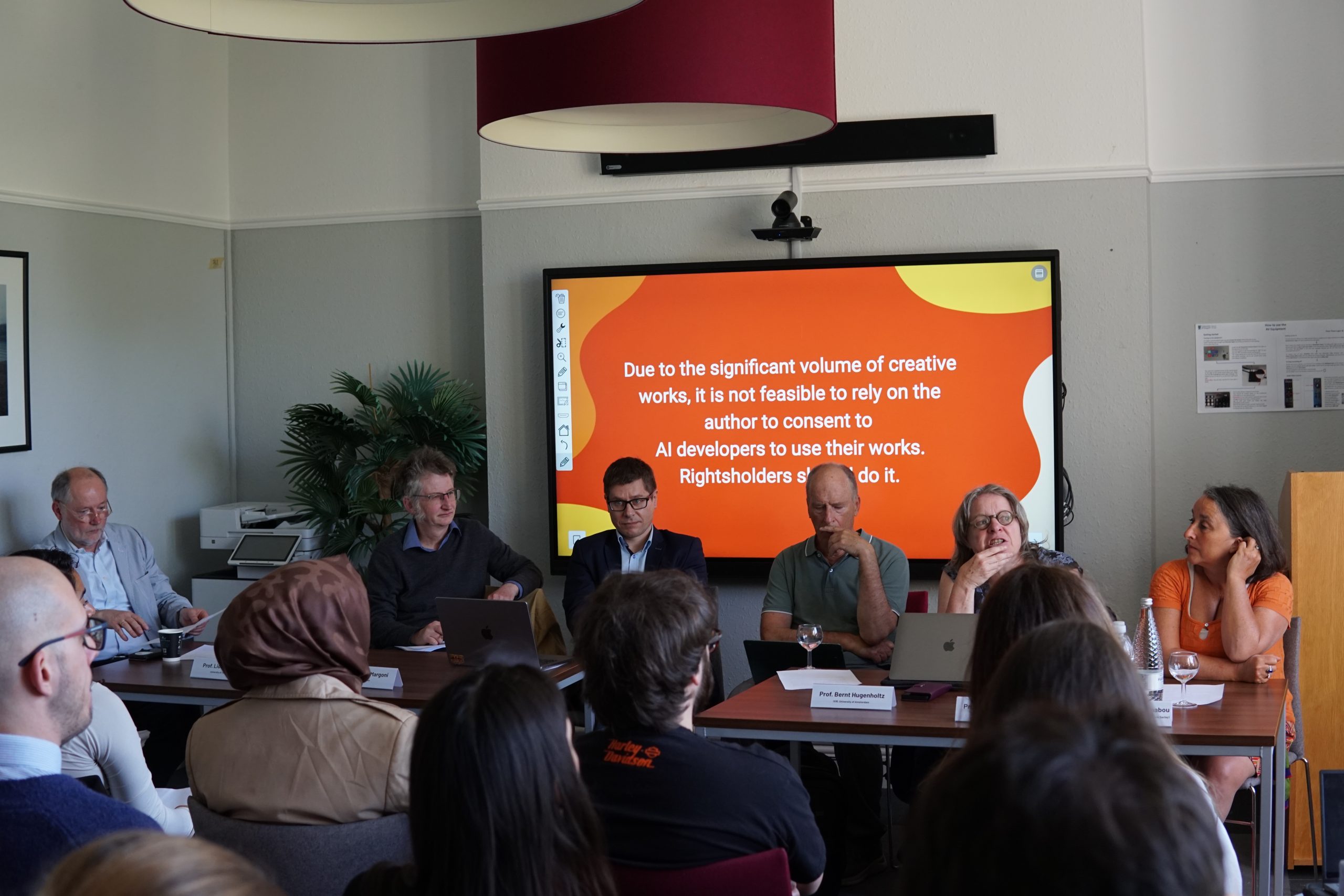
Some suggested alternative models, such as levies or other mechanisms outside of traditional copyright frameworks, especially since redistribution of income remains a fundamental challenge. Yet, these alternatives are not without limitations. Another thorny issue discussed was the opt-out mechanism for training datasets. While technically feasible—e.g., through metadata tagging—the panel warned that its implementation must be handled with care. In particular, the extraterritorial reach of such a system may conflict with the fundamentally territorial nature of copyright, raising questions about enforceability and jurisdiction.
Day two
The second day of the Spring School was devoted to the annual conference of the European Copyright Society (ECS), which, for the first time, welcomed Spring School participants — offering a unique opportunity to peek behind the curtain of cutting-edge academic debates and see how researchers are helping to shape the future of copyright law.
The morning began with Panel 1, focusing on creators’ unwaivable right to remuneration, particularly in the context of Articles 17 and 18 of the CDSM Directive, streaming platforms, and the growing influence of AI. The panel also addressed the Belgian Cour constitutionnelle’s 13 questions to the CJEU. Chaired by Prof. Séverine Dusollier (Sciences Po Paris), the discussion brought together leading voices such as Prof. Bernt Hugenholtz (IViR, University of Amsterdam) and Prof. Alain Strowel (Saint-Louis University and UCLouvain).
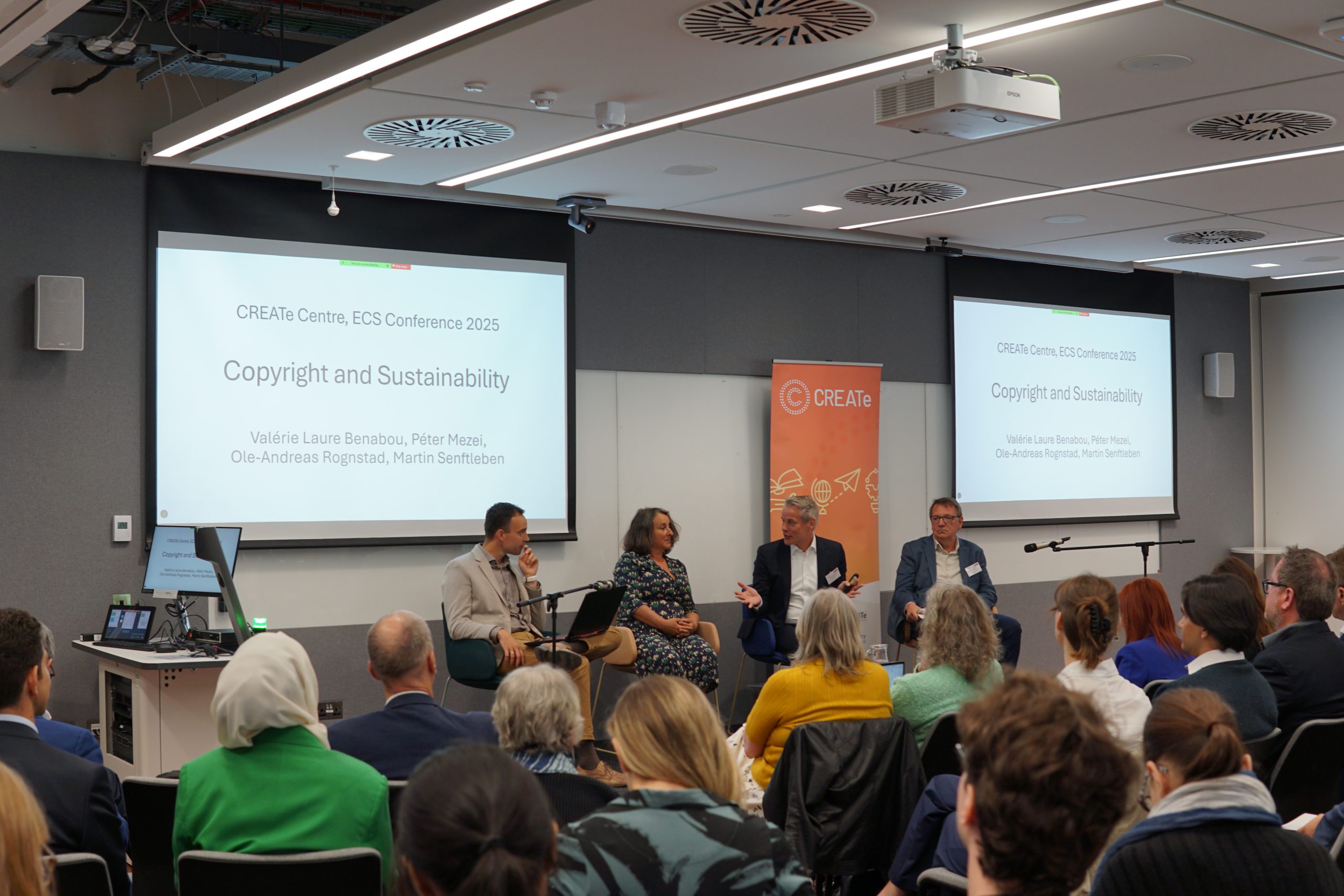
Next came Panel 2, centred on sustainability — with topics ranging from the stacking of rights to the right to repair, with reference to the Allposters case. Chaired by Prof. Martin Senftleben (IViR), the panel featured contributions from Prof. Valérie-Laure Benabou (Université Paris Saclay), Prof. Péter Mezei (University of Szeged), and Prof. Ole Andreas Rognstad (University of Oslo), who explored the complexities of copyright in circular economies.
The programme then shifted to a particularly lively post-Brexit discussion, provocatively titled “Is the UK taking CJEU jurisprudence too seriously?”. Chaired by Prof. Jonathan Griffiths (Queen Mary, University of London), the panel featured Prof. Lionel Bently (University of Cambridge) and Prof. Estelle Derclaye (University of Nottingham), who examined how UK copyright law continues—or chooses not—to align with EU jurisprudence post-Brexit.
In the afternoon, Panel 3 addressed democracy and the interplay between public-sector information, freedom of information, and copyright, drawing on the Public.Resource.org case. Chaired by Prof. Mireille van Eechoud (IViR), the session featured insights from Assoc. Prof. Martin Husovec (LSE) and Prof. Caterina Sganga (Scuola Superiore Sant’Anna, Pisa), highlighting the growing importance of open access to knowledge in democratic societies.
Panel 4 shifted the focus to innovation, exploring issues of lawful access, AI, and open-source licensing, through the lens of the LAION case. Chaired by Prof. Thomas Margoni (CiTiP, KU Leuven), the panel included interventions by Prof. Axel Metzger (Humboldt University, Berlin), Assoc. Prof. João Pedro Quintais (IViR), and Prof. Tatiana Eleni Synodinou (University of Cyprus).
The day concluded with a compelling ECS discussion, offering two directions for debate: “The world according to the EU’s AI Code of Practice” and “The future governance of copyright”. Moderated by Prof. Martin Kretschmer (CREATe, University of Glasgow), the session featured a dialogue between Prof. Alexander Peukert (Goethe University Frankfurt) and Prof. Pamela Samuelson (UC Berkeley).
Day Three
The third day of the Spring School was dedicated to the intersection of technology and regulation and opened with a particularly engaging session that gave the floor to three creators—Justin Alae-Carew, Rachel Johnson, and Soorin Shin. Each of them shared their firsthand experiences of working with digital technology, respectively in the gaming industry, craftmanship and design, and the world of image and music. Their contributions sparked a lively and thought-provoking discussion with the audience around the use of AI in the cultural sector and the evolving role of copyright, viewed through the lens of those who are directly affected by these tools in their professional lives.
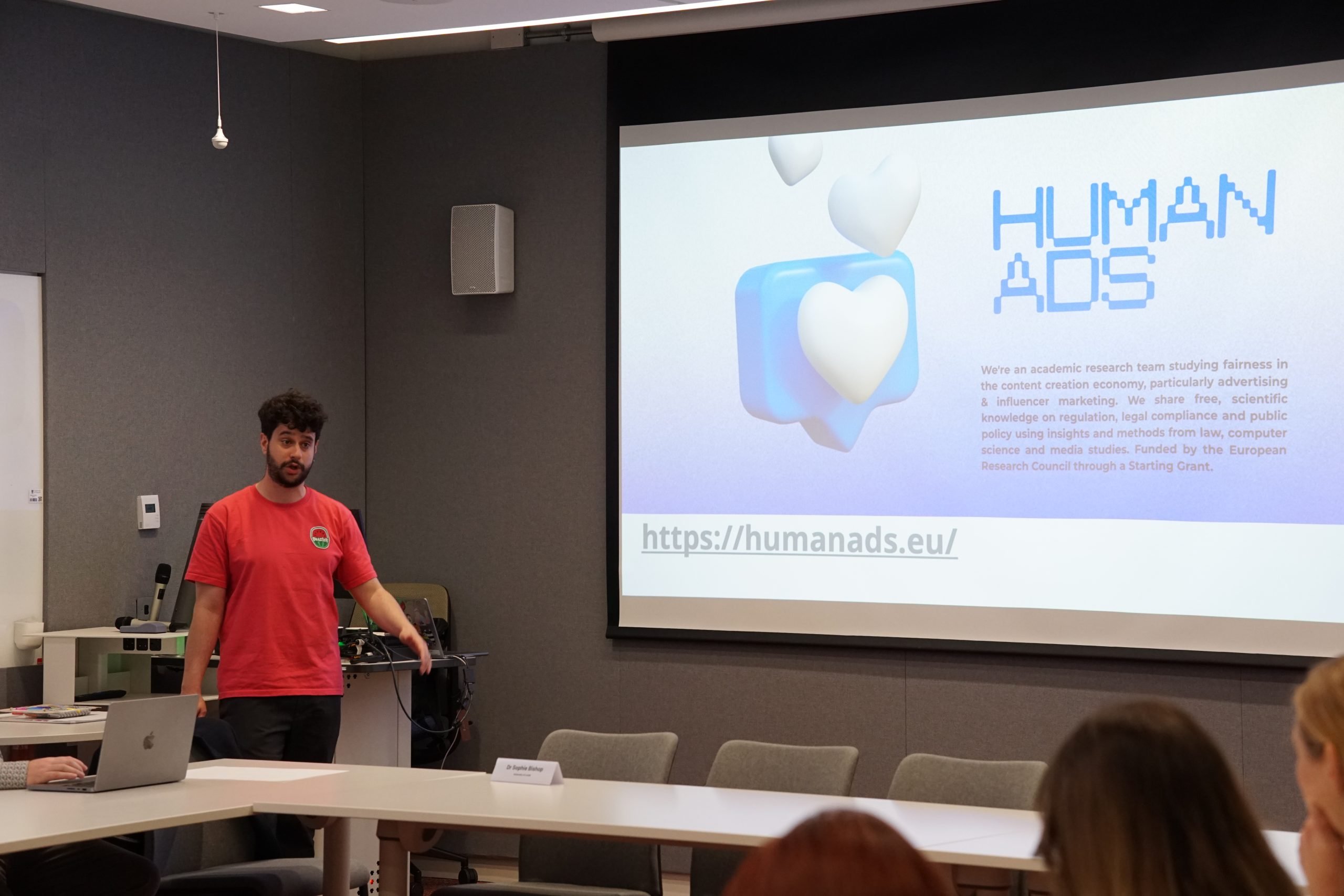
The session was followed by a rich and layered intervention from Sophie Bishop, author of the forthcoming book “Influencer Creep”. Drawing on her background in media studies, Bishop offered a critical exploration of the online worlds inhabited by influencers and digital artists and highlighted three recurring practices that define contemporary influencer culture and inform the so-called “influencer-informed strategies”: Optimization, Authenticity and Self-branding.
In the afternoon, Thales Bertaglia delivered an insightful talk titled “What Does Generative AI Really Mean for Creators and Platforms? A Computer Scientist’s Perspective”. With remarkable clarity, he translated complex technical ideas into accessible insights for a non-specialist audience. Striking a rare balance between overly technical detail and overly simplistic narrative, he challenged dominant discourses on AI often shaped by big tech. His presentation touched on key topics such as synthetic data, the stochastic paradox, the “AI winters”, and the nature of LLMs and GPT models—and a lot more.
To close the day, the conversation came full circle with a return to AI and creativity in practice. Erickson presented a talk titled “Experiments in Creativity: Locating the Human in AI Image Generation”, offering an engaging and entertaining real-world example of how copyright law can be applied to emerging creative processes. He showcased his project “A Stranger Things Fan Game”, built using large language models, and used it as a case study to explore what it means to “stretch” the TDM exception. His talk culminated in three timely questions: Have I infringed a rights holder’s copyright? What exceptions might apply under UK and EU law? And what uncertainties remain? These questions sparked a lively and thoughtful exchange with the audience, drawing on UK Section 29A of the CDPA and Articles 3 and 4 of the CDSM Directive. Together, we explored the limitations of these exceptions and reflected on the ongoing ambiguities surrounding key legal concepts — “lawful access” to third-party databases being a particularly notable example.
Day four
The final day of the Spring School opened with a sharp and insightful session on competition policy and economics in the creative industries, led by Morten Hviid. His lecture provided a structured overview, framed from an economist’s perspective, of the key areas of competition law, including its institutions and procedures. He introduced fundamental economic concepts such as consumer and supplier behaviour, market structures (ranging from pure monopoly to perfect competition), and vertical integration. Hviid also explored theoretical models like the principal-agent relationship and examined the very nature of the firm, ultimately posing the central question: Where do creative industries fit into this economic framework? His conclusion prompted a moment of reflection in the room, as he challenged a long-standing assumption in the field: “Without protection, there is no investment; without investment, no creative output.” With the rise of AI, he questioned, this principle may no longer fully apply.
Building on this, Joos Proost followed with a talk titled “Do They Come in Peace? How Technology Constantly Disrupts the Competitive Landscape in the CCIs”. Taking a pragmatic and dynamic economic perspective, he unpacked how fast-moving technologies consistently reshape the competitive environment of cultural and creative industries (CCIs). He tackled issues such as online piracy, the role of amateurs, the platformisation of content, and the disruptive potential of AI, all within the broader frame of how innovation continues to challenge traditional market dynamics.
In the afternoon, we heard from Konstantina Bania, who delivered an engaging talk titled “Regulating Platforms’ Market Practices: How Can Creators Leverage the Law to Tame Big Tech?”. She explored the unique characteristics of digital markets and offered a conceptual framework for understanding the complex relationship between content creators and platforms. Bania mapped out the current legal toolkit, highlighting both its opportunities and limitations—with a focus on protecting competition and regulating the power dynamics in digital content markets. Her closing remarks urged us to think creatively about how the law can support creators in a platform-dominated landscape.
And to finish… what better way to wrap up the Spring School than with a “Reflections session” on competition law in the creative landscape? The session was led by Magali Eben, who first took the opportunity to remind us that competition law serves the public interest, and that the invisible hand of the market should (ideally) work in favour of consumer welfare.
Divided into small groups, participants were presented with hypothetical scenarios and invited to reflect on a series of practical questions: What’s the core issue, and who is harmed? Is there a potential competition problem? Can competition law provide a solution?
This final exercise offered a meaningful opportunity to bring together the many threads woven throughout the week—law, economics, creativity, and technology—into a collective conversation about the kind of cultural and legal ecosystem we want to build, and how the law can help shape that future.
Looking forward to next year’s edition!