On 11 March 2024, the CREATe Centre was relaunched as the Centre for Regulation of the Creative Economy. The event reflected becoming part of the UK’s research infrastructure under a new 5-year award from the Arts and Humanities Research Council (AHCR).
We have now assembled a documentation of the exhibition, regulatory roundtable, keynote and speeches that took place in the University of Glasgow’s Advanced Research Centre (ARC).
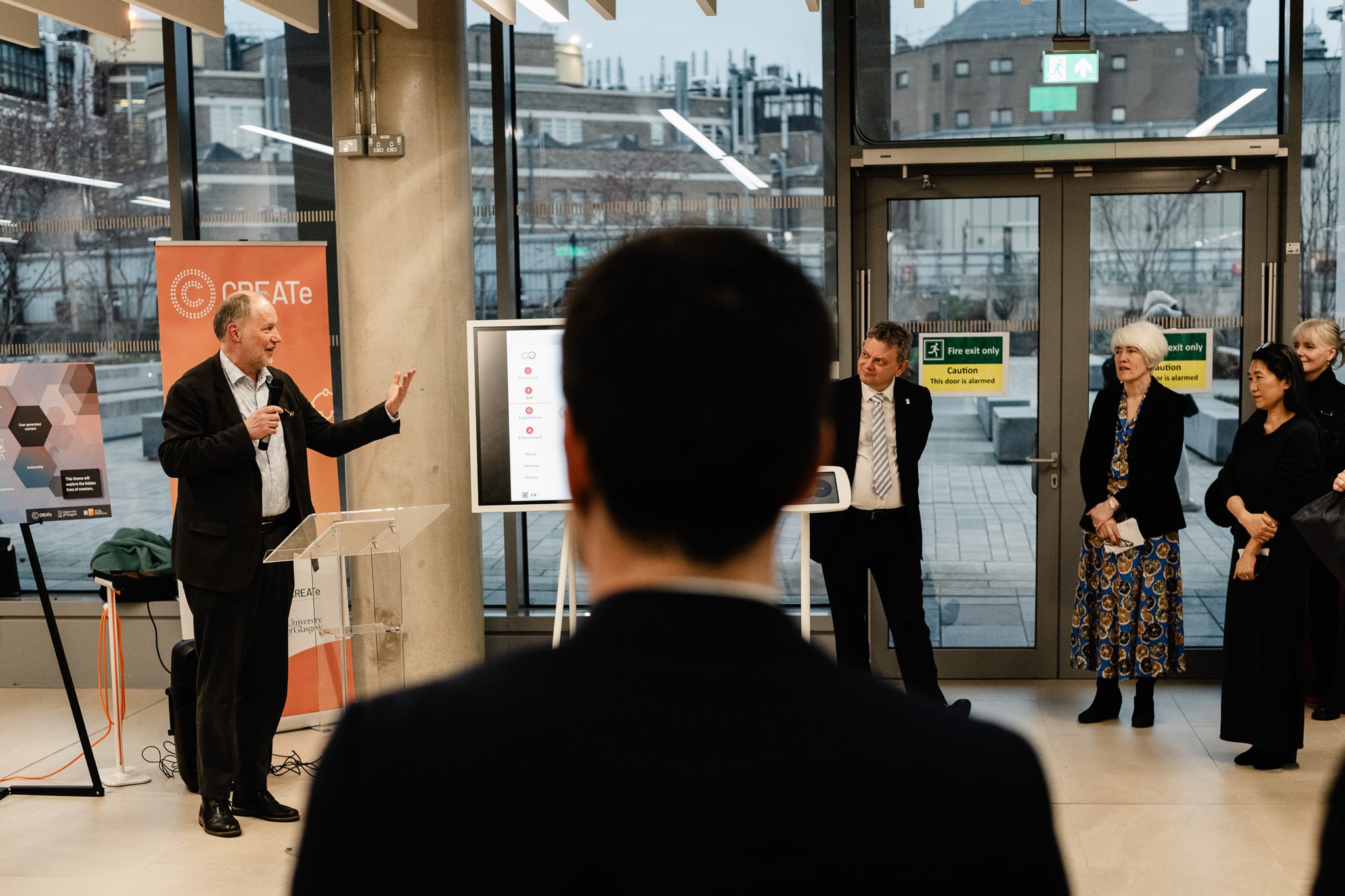
Please have a look, browse, reflect and challenge us. The resource page will become a permanent record of our new agenda, and hopefully serve as a tool for engagement and collaboration.
Below, I document the notes to my short welcome speech of 11 March.
Colleagues, entrepreneurs, artists, regulators, friends of CREATe:
Over a decade ago, I was standing next to the Principal to launch CREATe. CREATe was then a complex consortium of 7 Universities that arrived to high expectations in the Victorian surroundings of the Hunterian Museum.
Would I have believed that CREATe was still here today, as a University of Glasgow centre with a now global reputation, in the University’s new interdisciplinary flagship, the ARC?
12 years ago, we were part of the first round of major Centre investments led by the AHRC. The Arts and Humanities were beginning to think of national centres with a policy dimension.
We are the only Centre from that first round of AHRC investments that is still standing today.
We were, and I think still are, the only Centre that has received cross research council funding, from AHRC, EPSRC (Engineering & Physical Sciences), and ESRC (Economic and Social Sciences).
And today, we are celebrating another milestone. We are now considered to be part of the UK’s essential research infrastructure, with core funding for another 5 years. This too is a first for the AHRC, and we are proud of and grateful for the support and vote of confidence.
Speaking of firsts: Some of our colleagues and friends from CREATe’s inception are here today: Lilian Edwards (then at Strathclyde, as first deputy director of the consortium), Philip Schlesinger (deputy director for a full 12 years), Diane McGrattan (who was CREATe’s employee number one and is still working with us as centre administrator).
In 2012, CREATe’s agenda was set by a call for a national Centre for Copyright & New Business Models in the Creative Economy. It was the AHRC’s response to the digital crisis experienced first by the music industry (the canary in the coal mine), then by film, publishing, and soon the entire creative sector.
The digital genie was out of the bottle, with copyright law at the centre of a vicious debate (and litigation) between rightholders and unruly technology firms and consumers. The legal distinctions between original and copy, between public and private no longer seemed to work in a digital world.
But there was also a sense of optimism, with new industries being invented, such as games and social media; and opportunities from open knowledge approaches in (what became known as) the GLAM sector (galleries, libraries, archives and museum).
Today, we seem to be in a very different world dominated by BigTech firms and cultural (and actual) wars. The challenges of digital regulation and national sovereignty have added a layer to any creative economy discussion.
We have explored some of these issues today in our regulators’ forum with Ofcom, the Competition and Market Authority (CMA) and the Intellectual Property Office (as well as board members and front bench politicians).
We have explored some of these issues today in our regulators’ forum with Ofcom, the Competition and Market Authority (CMA) and the Intellectual Property Office (as well as board members and front bench politicians).
This widening agenda, and its urgency, is reflected in CREATe’s new footprint, that now extends to Competition and Technology Law. It is also reflected in the appointment of two Deputy Directors in these fields.
Dr Magali Eben, our competition law lead who will shortly chair Prof. Anu Bradford’s Digital Empires keynote, – and Prof. Kris Erickson who as professor of social data science brings much needed empirical expertise. Kris (with Bartolomeo Meletti) has been responsible for curating the exhibition of CREATe’s 7 new themes you can see around you.
Copyright law will remain an important anchor, as we see for example in the unresolved status of training data in machine learning/AI. The big questions of today need a wider scope, ranging from competition to communication, from data to intellectual property law.
It is still exciting to me today to see how CREATe is evolving. With the AHRC’s and the University’s support, I have every confidence that our fantastic young team will address the creative economy’s need for an evidence-based legal and regulatory understanding.
I am happy to invite now Prof. Sir Anton Muscatelli, Principal and Vice-Chancellor of the University of Glasgow to say a few words.
Martin Kretschmer, 11 March 2024