

 The 26th Annual Conference of the Association of Law, Culture and the Humanities, took place in May this year, hosted by the School of Law, University of British Columbia, Vancouver, Canada. Exploring the theme ‘Senses of Law’, the conference hosted interdisciplinary discussions in law and the humanities across some 50 different panels. Following on from our previous contributions to LCH conferences in 2022 and 2023, this year’s CREATe panel addressed ‘Art and Culture Through a Legal Lens: The Many Senses of Copyright and Cultural Heritage.’
First, Andreas Giorgallis, PhD Candidate in International Cultural Heritage Law, CREATe, University of Glasgow, opened with the presentation: ‘The Many Senses of the Idea of Protecting Cultural Heritage for the Benefit of Future Generations in International Cultural Heritage Law and Policy.’ Often considered the central reason why legal protection is afforded to cultural heritage, ‘the benefit of future generations’ is a fundamental tenet of contemporary cultural heritage law and policy. This presentation explored the ways in which this idea manifests in international and regional conventional and soft law, national law, jurisprudence, as well as various policy options. While its precise nature remains rather elusive in both its interpretation and application, Giorgallis argued that this idea comes with a certain ambivalence due to its chilling effect on what constitutes cultural heritage, how heritage can be appropriated and the neglect of intra-generational concerns in respect to cultural heritage. This presentation draws on a forthcoming paper: Giorgallis, ‘The Idea of Protecting Cultural Heritage for the Benefit of Future Generations in International Cultural Heritage Law’ forthcoming, International Journal of Cultural Property.
The second speaker mediated between international cultural heritage law and copyright law: Dr Pinar Oruç, Lecturer in Commercial Law at the University of Manchester and CREATe Fellow. In her presentation ‘Digitising The “Common Heritage of All Humankind”? Incompatibility Between Cultural Property and Copyright Law’, Dr Oruç made the case for the incompatibility of cultural heritage law and copyright law when it comes to digitisation practices of cultural heritage. Juxtaposing the different starting points, aims and particularities of each legal discipline she moved to address three areas of interaction, namely the preservation of cultural heritage, access to cultural heritage and its ‘repatriation’. Dr Oruç’s insights constitute part of her forthcoming monograph ‘Digitising Cultural Heritage: Clashes with Copyright Law’ (Hart Publishing and the Institute of Art and Law, The Art Law Library Series).
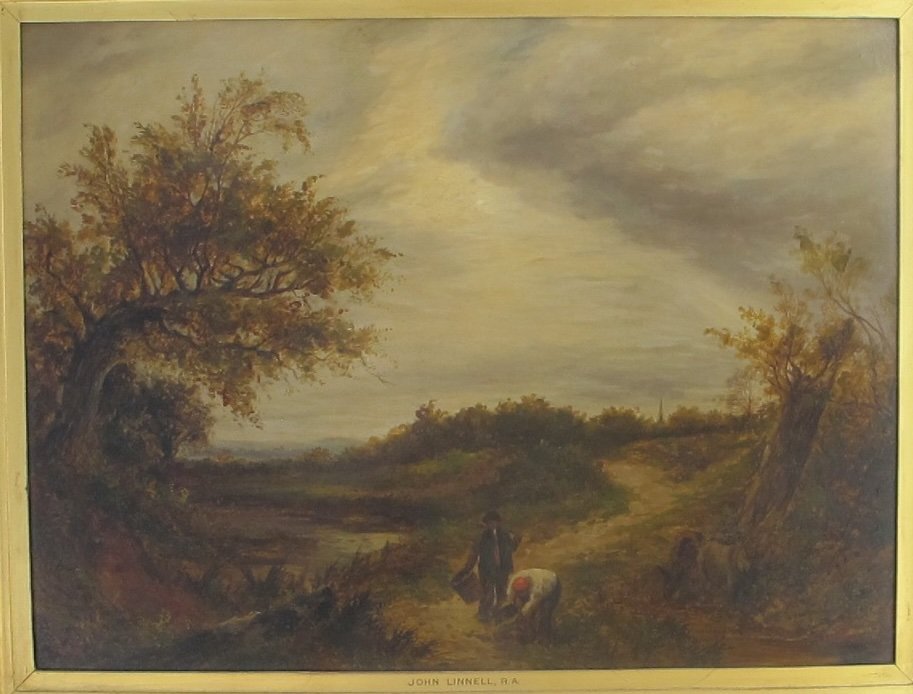
19th century unauthorised copy of John Linnell’s Heath Scene (courtesy of Linnell’s descendants)
The final speaker Dr Elena Cooper, Senior Research Fellow, CREATe, who also chaired the panel, presented ‘Going Beyond Nineteenth Century ‘Moral Rights’: Unravelling the Multiplicity of Legal Senses of Section 7 UK Fine Arts Copyright Act 1862’. Dr Cooper undertook a historical analysis of nineteenth century statutory penalties for fraudulent acts involving false signatures on paintings, uncovering their multiple senses: not only protecting artists, but also protecting collectors against artists that falsely applied their own signature to works produced by their assistants. In doing so, Dr Cooper drew on her original archival work about the criminal law context for section 7 of the 1862 Act: the decision in R v. Closs (1857), an unsuccessful prosecution for forgery and cheat relating to an unauthorised copy of the painting Heath Scene by John Linnell, bearing an imitation of Linnell’s signature. Dr Cooper’s research into the historic role of the criminal law in the domain of intellectual property is part of a wider project funded by The Leverhulme Trust.
Comments were gathered for all presentations at the end which resulted in interdisciplinary discussions about the definition of cultural heritage, the relationship between copyright law and cultural heritage law in instances of digitisation as well as the broader cultural context in which Section 7 of the Fine Arts Copyright Act 1862 operated. The conference’s full programme is available online. Details for any future conferences organised by The Association for the Study of Law, Culture, and the Humanities can be found online.
To receive updates from the Legal History and Cultural Memory Theme, sign up to the CREATe newsletter.