


By Jessie Yingying Zhu, CREATe PhD Researcher
The 19th Academic Society for Competition Law (ASCOLA) Annual Conference took place between 4-6 July 2024 at Julius-Maximilians-Universität Würzburg in Germany under the leadership of Florian Bien and Björn Becker. The annual conference brought together competition scholars from all over the world. As a junior ASCOLA member attending for the first time, I found the experience to be incredibly impressive! Beyond the in-depth and high-quality discussions of scholarship, there were dazzling socials each evening after the panels: an official opening closed by Baroque Music (performed by the Young Chamber Orchestra Würzburg), enforcer and scholar panels, a BBQ with live jazz, the first ASCOLA concert performed by ASCOLA members and the ASCOLA band in the Wurzburg Residence, a UNESCO World Heritage site, dinner and wine tasting in the Staatlicher Hofkeller, lunch at the Bürgerspital Weinstuben, one of the three Spitals in Würzburg, care establishments funded by their wineries. To these one should add the coffee-fuelled academic debates after each panel. We appreciate the organisers for the extraordinary job they did in ensuring the success of the annual conference.
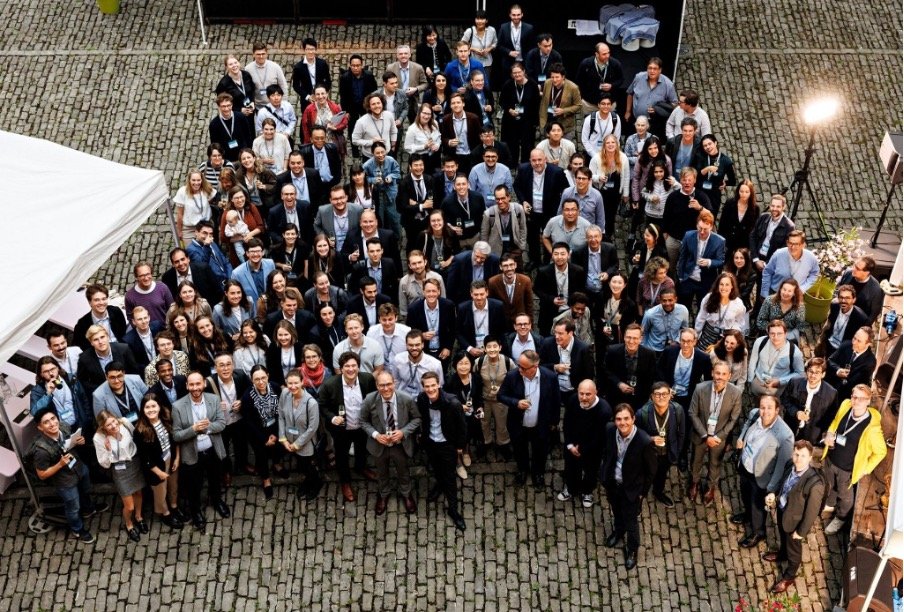
Credits: ascola.org, photo by Andreas Grasser ©
The conference was particularly impressive for me as a new participant due to its rigorous presentation selection process. It was the first time that I received written feedback and revision suggestions for my submission to a conference (A special thanks goes to the reviewers). Each of the 146 submissions was assessed by at least two experienced reviewers in a double-blind process. During the conference, competition scholars were provided with opportunities for academic debates, with 25 panels, several plenary sessions, and many participants from all over the world. CREATe was well-represented at the conference, as it was attended by Magali Eben, Matteo Frigeri, Stavros Makris, and myself, Jessie Yingying Zhu.
Magali was active throughout the conference in various roles –– presenting her co-authored work with Matteo as a speaker, greeting everyone in socials, discharging her duties as a member of the ASCOLA executive committee at the general assembly, and providing comments and suggestions as a discussant on the excellent work of Filip Lubinski – “From Neoclassical Economics to Complexity Science” – and Velizar Kirilov – “A Dynamic Perspective on Biosimilar Competition”; both from the European University Institute.
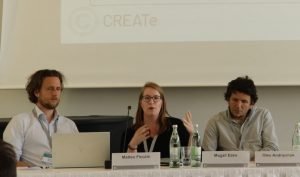
Matteo and Magali on e-lending
Matteo and Magali presented their co-authored work with Martin Kretschmer and Kenny Barr on “Dysfunctional Equivalence? A Competition Law Analysis of the eLending Market”. The paper complements a CREATe project, “The Law and Economics of e-Lending in Europe”, funded by KR21. The paper explores the need for policy interventions from both Competition and IP law perspectives in the e-Lending market for Educational and Trade eBooks. The CREATe team have complemented the literature with semi-structured interviews and contracts analysis. They selected four countries (the United Kingdom, Ireland, Poland, and Denmark), and carried out a total of 12 interviews to find potential evidence of abuses of dominance. Against this backdrop, Matteo introduced the failure of the copyright legislation in applying the “essential function of copyright” doctrine and embodying the spirit of the law. Magali then assessed, from a competition law perspective, different types of behaviour that may raise potential competition-relevant effects –– delay of titles in the market for public libraries, withdrawals of titles by publishers in the market for academic libraries, unfair trading conditions in exploitative cases, charging of excessive pricing, using data to set prices, avoidance of the law as an abuse. Based on the analysis, Magali concluded with five questions about potential abuses in the eLending market, which sparked discussions among the audience.
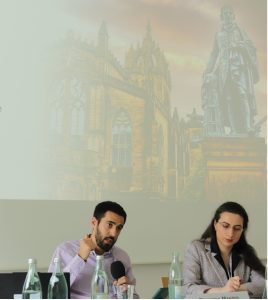
Stavros discussing Adam Smith
Stavros presented his paper on “A Smith-Inspired Political Economy Approach for the Competition Law of the 21st Century”. In this paper, Stavros emphasised how modern Adam Smith is and explored how the work of the Scottish philosopher can inspire substantive and methodological recalibrations of competition law beyond the prescriptions of the neoclassical competition policy. Stavros first explained how the Wealth of Nations can explain and ground the fundamental assumptions of competition law (Markets are considered the primary mechanism for the production & allocation of goods; competition is deemed as worthy of protection; market power can lead to market failures to the detriment of consumers and society at large). The fact that we can understand the rationale and the raison d’etre of competition law in a work written in 1776 is truly remarkable. Then Stavros explored how Smith’s thought could help us in identifying when competition law is not enough and needs to be complemented by another legislation. Stavros also argued that Smith’s dual ideal of freedom as non-domination and prosperity of the least fortunate ones can inspire two new standards – the effective competitive constraints standard and the most vulnerable consumer standard – which could complement the currently dominant consumer welfare standard and address some of its shortcomings. Lastly, Stavros made the point that Smith could be conceived as an early complexity thinker, and, thereby, inspire authorities to go beyond the methodological prescriptions of the neoclassical economics to complexity science to understand and address competition-related market problems. His paper is forthcoming, but you can get a foretaste here .
As a participant of the conference for the first time, I learnt a lot from various stages of competition law research outcomes –– the “normal” paper presentations, presentations of PhD projects with more intense feedback, and pitching ideas at an early stage of research. I had never experienced an academic conference that was so enjoyable while also providing such a wealth of cutting-edge competition law perspectives. From now on, I plan to attend every year. Next year’s conference will take place in Chicago, and CREATe hopes to see you there!
To stay up to date with our competition law and access to knowledge work subscribe to our newsletter.