
Evidence on Technological Protection Measures: impact on research, education and preservation
Project Overview
Exceptions to copyright exist in Europe and elsewhere to enable beneficial uses such as research and preservation, however the legal status and impact of technological protection measures (TPMs) on these activities remain unclear. TPMs, designed to control the way in which users access digital content, may override lawful activities granted by the legislator, with those removing or circumventing them facing penalties unless they obtain specific authorisation.
Despite provisions in the law to ensure that TPMs cannot be used to prevent legitimate uses, there is relatively little information as to how they apply in reality, and the challenges and frustrations felt by those who encounter them.
This research has the following aims and sub-projects:
- Understand the status of TPMs and their relationship to exceptions in EU Member States and other jurisdictions;
- Survey researchers and research organisations about the challenges encountered due to TPMs and the possibility of circumventing them; and,
- Develop economic evidence on the overall welfare effects of TPMs and their ramifications on access to knowledge.
Our first report has now been published and upcoming outputs will be linked below as they become available.
Funder
Team
Principal Investigator
Prof Kristofer Erickson
Co-Investigators:
Martin Kretschmer
Anthony Rosborough
Ula Furgal
Marcella Favale
Victoria Stobo
Data developer
Felix Rodriguez Perez
Duration
2023 – 2024
Report 1: Legal status of TPMs
Led by Anthony Rosborough, we produced a report on the legal status of TPMs in selected European comparator jurisdictions. The report includes a history and typology of TPMs and a discussion of the relationship between TPMs and the enjoyment of exceptions. This includes identifying relevant national authorities and processes for requesting the removal of TPMs. A significant portion of the report, supplemented by qualitative evidence gathered from practitioner institutions, explores the current practices and points of frustration encountered by research, education and preservation institutions when dealing with TPMs in the course of fulfilling their public roles. The report provides legal and policy analysis building on the doctrinal and empirical data gathered from institutions / national authorities. Where systems for requesting removal of TPMs exist, such as the UK, the report discusses the procedure and resource costs involved for institutions navigating the circumvention measures as outlined in national law. Download the report here 👉
Report 2: Survey on Research and Preservation
Led by Kristofer Erickson, this study provides an updated, comprehensive cross-European survey of the impact of TPMs on privileged beneficiaries of copyright exceptions (Akester, 2009; Favale, 2011; Livermore, 2015; Kampen, 2016). The sample includes individual researchers as well as educational and research institutions and their affiliates. We use a survey/structured interview approach to investigate current practices among a purposive sample of institutions of varying sizes from selected territories across Europe. The survey gathers information about institutional response to TPMs across the range of digital content identified in the call (eBooks, e-journals, film, videos, games, sound recordings, databases, streaming services). Institutions were asked to provide specific information on costs and resources allocated to challenges presented by TPMs in their activities. This report also investigates the possibility for institutions to request removal of TPMs through legal means, and the costs and challenges involved in making those requests. Download the report here 👉
Report 3: Impact of TPMs on Video Game Preservation
Led by Kristofer Erickson, this project collected new data to study whether the presence of copyright TPMs on video game hardware hinders preservation and research. The data comprise 14,300 electronic devices (mostly arcade machines and consoles) from 1970-2023. The study focuses on the Multiple Arcade Machine Emulator (MAME) project, the longest active open-source emulation project. The data are combined from several sources: the MAME 0.258 ROM set from Internet Archive, the MAME developer Wiki, and a volunteer online database from Italy, which contains metadata about emulation compatibility. We data mined the repository to find instances where MAME developers encountered copyright security TPMs when trying to preserve old games. Further statistical analysis examined whether the presence of TPMs caused any significant delay in preservation for machines that were protected, to measure the social cost of TPMs in the context of long-term preservation. Download the report here 👉
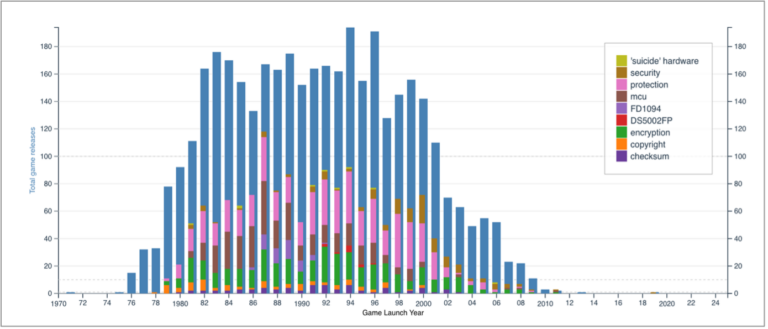
Screenshot from the Explorer, showing prevalence of TPMs in video game machines from 1970-2023. Click the image to access the interactive resource.
Related Outputs and Resources:
Report mentioned on TechSpot – January 2025
Report mentioned on TorrentFreak – January 2025
Final Project Report: Technological Protection Measures and Digital Preservation: Evidence from Video Games – December 2024
Final Project Report: Survey on Technological Protection Measures: Impacts for researchers, libraries and archives – December 2024
Final Project Report: Technological Protection Measures & the Law: Impacts on Research, Education & Preservation – November 2024
Data Visualisation Tool: Video game preservation explorer – March 2024
Press Release: TPMs survey for libraries and researchers – February 2024
Press Release: TPMs project funding announcement – December 2023
Funder
Team
Principal Investigator
Prof Kristofer Erickson
Co-Investigators:
Martin Kretschmer
Anthony Rosborough
Ula Furgal
Marcella Favale
Victoria Stobo
Data developer
Felix Rodriguez Perez
Duration
2023 – 2024